For someone who spends so much time testing and reviewing rules, and chatting with rules designers, I do very little official playtesting. Simple reason: good playtesting is too much like hard work.
It's also something almost no one does properly - in fact it's almost an impossible task.
According to the old science curriculum, there are a few elements that make a "fair test"of something. Amongst them are some pretty tough hurdles for a game designer to overcome:
*All variables should be considered and controlled
*The experiment must deal with the question being studied
*Only one variable should be altered at a time
*The experimenters should not be biased
*Conclusions drawn must be better than those from chance
*Experiments must be able to be replicated
So to fairly or properly playtest something in a scientific manner, there are a few things to consider:
Playtesting is difficult, when the subject involves chance, and the testors themselves are both a "variable"and likely biased.
*All variables should be considered and controlled
This is almost impossible in a wargame where testers will themselves are directly involved and not independent observers - they vary in playing skill, experience and their comprehension of the rules - the testers themselves are an uncontrolled variable!
*The experiment (game) must deal with the question being studied
Well obviously, the playtest deals with the game. But what is the "question"the game dev is asking of his testers? Is he wanting to know if the game is fun? realistic? too slow? to confusing? feedback on a particular mechanic? - to get specific feedback the designer needs to pose specific questions for the playtesters.
*Only one variable should be altered at a time
This article was inspired by the v3 Infinity rules. There was changes in "to hit" modifiers of weapons at different range bands. As shooting is very important in Infinity, the designers took a very careful approach. They would change the ranges on a single weapon (keeping all the other weapon ranges and rules the same) play a bunch of games, then change and test another weapon. In a game with dozens of weapons, this means a LOT of playtest games. In addition, they broke it down further - they experimented with the modifiers within each range band, for each weapon. That is hundreds of playtest games - something Infinity, with its established and large loyal fanbase can do; but a bit harder for the average self-published game designer. Most games go through various "alpha" and "beta" incarnations but I doubt many companies would have so many playtest games simply to fine-tune a single weapon.
The problem with changing many variables is you do not know which change had the most impact on gameplay. Even companies with the capability to do this often miss this piece of common sense; i.e. in video game companies when they can easily "patch" a particular weapon by simply typing a few lines of code, when they "balance" things they often mess with several variables. For example: I played a PC game where armed dune buggies ran rampant. They were so fast they could engage and flee at will, they could be repaired while moving, and they were tough. In addition, they wielded a powerful bazooka. These buggies were death machines, able to take out MBTs and infantry, their self-repairing and agility making them nigh-immortal to all foes - even gunships and aircraft. The company responded. But they changed multiple variables. They reduced the weapon power, made the buggy very fragile, reduced the ability to repair while moving, and lowered the speed. The buggy then became useless. And the company could not point to the exact reason, due to the mass of changes they made. The company should have reduced ONE variable (such as speed), tested it, then reduced another variable (say weapon damage) until the buggy reached a state of "useful but not overpowered."
*The experimenters should not be biased
Most playtesters are drawn from local clubs and friends (even ones you only deal with via email may form an emotional attachment and investment to you and your project; the loyalty that makes them a "good" playtester may also bias their opinions).
*Conclusions drawn must be better than those from chance
The very nature of our card-based and dice based wargames means chance plays a large part in any game and lucky rolling can change gameplay outcomes a lot. Whilst we can usually recognize unusually lucky/unlucky dice rolling, the strong element of chance in wargames makes feedback less reliable - which brings even more emphasis to the following:
*Experiments must be able to be replicated
I'd reword this simply as "experiments must BE replicated." Wargame playtesting has problems - the element of chance, and our playtesters are who likely biased; and themselves a "variable" differing in ability and understanding. This is where repeating the "test" leads to more reliable results. If you slip a coin once, and it lands on heads, you might conclude the coin will land on heads every time, or the majority of the time. However flip the coin 100 times, and you will probably realize it is likely to be around 50/50. Flip it 1000 times, and you will increase the accuracy of your experiment. Obviously game designers are limited in the number of tests they can make - but the point is, the more tests (games), the more accurate the data.
TL:DR
As you can see, it is well-nigh impossible to test a wargame "scientifically." Many elements of a proper test are outside the game designer's control. However we can learn from the principles of a "fair test"- I'd like to draw attention to those aspects which ARE controllable:
*Have a focus for feedback. The game dev should seek specific feedback, perhaps by posing focus questions that playtesters can respond to.
*Only change one thing at a time. Change one or two small things, then test. Overhauling masses of features and mechanics can make it unclear what is causing changes/aspects of gameplay.
*Test repeatedly. The more test games, the better the results.
Sadly, these often involve more effort than people are willing (or even able) to spend; it's a little wonder we have so many wargames which are confusing, frustrating or exploitable. In fact it's remarkable we have so many good games, when you consider the difficulties. Hats off to the valiant game devs and playtesters!
Rabu, 17 Desember 2014
Selasa, 16 Desember 2014
Game Design #16: Record keeping, Counters and Bookkeeping
This article has perhaps been coloured by my introduction to wargaming; four vastly different games in the bookkeeping spectrum - Starfleet Battles (need a degree in accounting), General Quarters, Rapid Fire and DBA (record keeping, what record keeping?).
Argument:
1. Record keeping needs to have an enhancing effect on gameplay
2. Game designers need to judge the tradeoff between the benefits of record keeping and time
I'm approaching this article with a few thoughts:
What is an acceptable amount of book keeping? When is it uneccessary?
When does record keeping add value/interest to a game?
What about the infamous "Hit Points"?
Decisions vs Resolution
Decision making - where you are deciding the actions of your forces
Decision resolution - measuring, moving models, chugging dice, record keeping
A good game maximizes decision making, and minimizes time spent "resolving."
However having good resolution mechanics can enhance the game and decision making.
Sometimes the record keeping enhances the game, and is worth the time taken to do it.
Example: You have thought up this really cool magic mechanic that allows you to create your own spells on the fly. It makes your skirmish game unique. However it requires you to track each model's magic points with counters and adds 50% more time to a game turn; the average game has gone from 2 hours to 3 hours. Is it worth including?
Recording in Skirmish Games
Most platoon-level+ infantry games have a binary dead/alive mechanic; a figure is either alive and fully functional or dead and removed from the table. However skirmish games often use ""hitpoints" like their RPG cousins. Is this needed?
Let's look at some "categories of injuries" - if we ignore insignificant cuts, bruises etc which have little effect on fighting ability, and we also ignore death/critical injuries that means they can play no further part in the fight we are left with:
Minor - deeper cuts, cracked ribs and similar which impede fighting ability somewhat
Major - broken limbs, severe concussion - injuries which severely handicap fighting ability
Ongoing - injuries which worsen over time; i.e. bleedout, poison or being on fire
You can correctly point out these conditions are hitpoints under another name; but the point is there's no reason for more than 2-3 hitpoints; and it is the condition the character (effects of injury/status) that should be the focus. A game where a character can have 1 out of 10 hitpoints left and function perfectly fine, is wasted book-keeping. Why am I ticking boxes if nothing happens in game?
Good Example: I liked the cinematic effects of melee in Song of Blades - minis could be pushed back (creating new tactical possibilities), knocked down (where they were easy to finish off), killed or even spectacularly killed (with morale effects on those standing nearby.) There was no record keeping and the four different effects were all done in a single die roll (which was the to hit AND damage die roll). That's an example of it done right - minimal record keeping and die rolling, but lots of interesting gameplay effects.
Recording methods: Counters vs Cards
Whilst scribbling down notes on a piece of paper has thankfully become something of an anomaly, we have two main forms of record keeping which are trendy at the moment.
Games like Warmachine (and its sci fi spin-off Gruntz) have popularized the use of small unit cards. They even have handy computer programs allowing you to produce and print your own. In neat card sleeves, these can look quite attractive beside the table and are a handy reference.
Another option is the use of counters. A lot of people dislike these, saying they clutter the tabletop, but I notice the people who are artistic enough to care are also usually good at thinking up cool markers that "fit"with the theme - i.e. blood spatters on a clear counter for a damage marker, or a specially decorated base/diorama. Basically, if they can make a lovely terrain board, they can also make cool counters that fit. If they don't, they shouldn't be complaining, as they probably have bigger immersion-breaking aesthetic issues than a few counters.
Written orders are another form of book-keeping. Designers seem to be increasingly getting round this, and I would say this is something that needs to be very carefully considered before we include this in our game. Do we want our players to be writing stuff down, or pushing miniatures around the table? It also has obvious time considerations. Personally I find written orders in aircraft games (Check Your Six is a popular example) as a major immersion breaker - in a fast paced form of combat, it seems weird to pause from the game and write "left turn, up one level, +1 speed" - then reveal moves like the end of a poker game. However, written orders in plane games are "traditional" so I'll probably get shouted down on this. (I'll have to do an article on "traditions in wargame genres"- it's amazing how rules within a genre tend to follow certain conventions).
Hitpoints (Ok, this is a bit of a hobbyhorse of mine, but I enjoy flogging it...)
Hitpoints can take many forms. Removable miniatures on a base (i.e. 20 elves on a movement tray in Warhammer Fantasy) are effectively hitpoints of a single unit. (It's a reason I hate WFB - the back rows of troops in a formation are, effectively, elaborately painted hit markers. And I dislike meaningless painting) Actually the one that takes the cake was a Mantic game (KoW?) - you have a block of 20 troops, but instead of removing minis you add hit markers.... logically, either the 20 models or the counters are unnecessary)
Meaningless hitpoints
I dislike Aeronef's hitpoint system - a dreadnought might have 32 hitpoints, and nothing happens until you tick off 8, then you remove 25% of firepower/speed. Then you tick off another 8, and remove 50%. Basically I ticked 32 boxes and got three gameplay effects (four if you count removing the exploded 'nef at the end) That's a lot of meaningless box ticking (and dice chugging to get those hits) - lots of "resolution time" without adding any "decisons." I'm sure when a real ship gets shot, and its speed drops to half speed, the captain doesn't say "relax boys, it's another 8 hits before anything else bad happens!"
Hitpoints are particularly prevalent in naval/space games. However I am dubious a real spaceship/ship captain would know (or even care) if he had 18% or 20% hull damage, or even be able to tell the difference (Ok, maybe on Star Trek...) A task force or fleet commander (most wargames you have 4+ ships) would be even less precise. I'd suggest they'd be more concerned about what was broke, and what wasn't.
"The point defence is out of action"
"We can only make half thrust"
"The fires are out of control on the hangar deck"
"All aft turrets knocked out"
Most games have "critical hit" systems tacked on, but I'd suggest it is the "criticals" a task force commander would be most interested in - not if a particular ship under his command had 67 of 80 hitpoints. I'd suggest a fleet admiral would be even less concerned with particulars - probably more in terms of if a ship could keep formation, defend itself or launch attacks effectively.
Hull integrity IS a factor - it's important to know when you have more holes than hull/when you're about to run out of duct tape - but it can be abstracted to its effects - which is all we care about. The author of Bulldogs Away concentrates on the effects:
Damaged
Heavily Damaged
Wrecked/Crippled
"Kaboom"
Again, I agree these are just renamed "hitpoints". Basically, the three damage stages aligns with the meaningful 3 effects from Aeronef (the 25%, 50% and 75% penalties) - without all the box ticking in between.
My point is, from the viewpoint of a task force/fleet commander (which we, as players, tend to be) dozens of hitpoints are needlessly excessive. Game designers need to concentrate on the effects of hits. If the hits are meaningless (the shot knocked over the captain's coffee mug or shot the tail off the ship's cat) then why are we recording them?
When is record keeping a good thing?
When it enhances your game. When it is the only way to do x in the game. When it introduces gameplay decision-making tactical opportunities that outweigh the complication/time cost.
For example, Infinity has an "order pool" of counters or markers. This is record keeping. However it is GOOD record keeping, as:
(a) it allows a unique activation effect where one unit can act more than once
(b) it adds a layer of resource management
(c) it is simple and quick to resolve (just remove counter every time you activate a model)
The order pool is record keeping, but it enriches gameplay with an insignificant trade-off in time/complexity. This is a great example of good record keeping.
Another good example is the use of Might, Will and Fate points in the LoTR:SBG. These are "resources"which need to be recorded (usually represented by counters but can be noted down). However they can only be wielded by heroes (which are relatively few - say 2-3 in a game) so the overall time/complexity issue is minor. In return, they add a layer of tactics and resource management. Players can spend them to influence die rolls OR the activation/move sequence.
There are other times when record-keeping seems unavoidable. In age of sail games, the objective was often to capture rather than sink an enemy ship: by slugging away at it (often over hours), killing crew, knocking down rigging, and taking weapons (often 74+ cannons) out of action. Whilst I would LOVE a book-keeping free age of sail game, I don't see how one could capture the flavour and combat of the period.
TL:DR
Record keeping should have a direct impact/effect on gameplay - there should be no meaningless box ticking.
When a game designer introduces any form of record keeping, he should ask himself if it is worth the tradeoff. Does it introduce decisions, tactics and gameplay depth that offsets the tradeoff in time/complexity?
I knew someone who owned an incontinent Persian cat. The owner thought it was amazing little precious fluffums. To everyone else it was a pest who constantly p***ed on the furniture. The point I'm making is the game dev may think his rule is brilliant, but as it his special brainchild he may not be able to see it is a problem in the long run. That's where playtesters come in - a component increasingly bypassed in an era where self-publishing is easy.
Record keeping can add decisions, tactics and depth to a game. Sometimes record keeping might be unavoidable. However, we need to always check - is the tradeoff worth it?
Argument:
1. Record keeping needs to have an enhancing effect on gameplay
2. Game designers need to judge the tradeoff between the benefits of record keeping and time
I'm approaching this article with a few thoughts:
What is an acceptable amount of book keeping? When is it uneccessary?
When does record keeping add value/interest to a game?
What about the infamous "Hit Points"?
If you wondered why I am passionate about record keeping... this was my introduction to wargaming...
Decisions vs Resolution
Decision making - where you are deciding the actions of your forces
Decision resolution - measuring, moving models, chugging dice, record keeping
A good game maximizes decision making, and minimizes time spent "resolving."
However having good resolution mechanics can enhance the game and decision making.
Sometimes the record keeping enhances the game, and is worth the time taken to do it.
Example: You have thought up this really cool magic mechanic that allows you to create your own spells on the fly. It makes your skirmish game unique. However it requires you to track each model's magic points with counters and adds 50% more time to a game turn; the average game has gone from 2 hours to 3 hours. Is it worth including?
Recording in Skirmish Games
Most platoon-level+ infantry games have a binary dead/alive mechanic; a figure is either alive and fully functional or dead and removed from the table. However skirmish games often use ""hitpoints" like their RPG cousins. Is this needed?
Let's look at some "categories of injuries" - if we ignore insignificant cuts, bruises etc which have little effect on fighting ability, and we also ignore death/critical injuries that means they can play no further part in the fight we are left with:
Minor - deeper cuts, cracked ribs and similar which impede fighting ability somewhat
Major - broken limbs, severe concussion - injuries which severely handicap fighting ability
Ongoing - injuries which worsen over time; i.e. bleedout, poison or being on fire
You can correctly point out these conditions are hitpoints under another name; but the point is there's no reason for more than 2-3 hitpoints; and it is the condition the character (effects of injury/status) that should be the focus. A game where a character can have 1 out of 10 hitpoints left and function perfectly fine, is wasted book-keeping. Why am I ticking boxes if nothing happens in game?
Good Example: I liked the cinematic effects of melee in Song of Blades - minis could be pushed back (creating new tactical possibilities), knocked down (where they were easy to finish off), killed or even spectacularly killed (with morale effects on those standing nearby.) There was no record keeping and the four different effects were all done in a single die roll (which was the to hit AND damage die roll). That's an example of it done right - minimal record keeping and die rolling, but lots of interesting gameplay effects.
Recording methods: Counters vs Cards
Whilst scribbling down notes on a piece of paper has thankfully become something of an anomaly, we have two main forms of record keeping which are trendy at the moment.
Games like Warmachine (and its sci fi spin-off Gruntz) have popularized the use of small unit cards. They even have handy computer programs allowing you to produce and print your own. In neat card sleeves, these can look quite attractive beside the table and are a handy reference.
Another option is the use of counters. A lot of people dislike these, saying they clutter the tabletop, but I notice the people who are artistic enough to care are also usually good at thinking up cool markers that "fit"with the theme - i.e. blood spatters on a clear counter for a damage marker, or a specially decorated base/diorama. Basically, if they can make a lovely terrain board, they can also make cool counters that fit. If they don't, they shouldn't be complaining, as they probably have bigger immersion-breaking aesthetic issues than a few counters.
Written orders are another form of book-keeping. Designers seem to be increasingly getting round this, and I would say this is something that needs to be very carefully considered before we include this in our game. Do we want our players to be writing stuff down, or pushing miniatures around the table? It also has obvious time considerations. Personally I find written orders in aircraft games (Check Your Six is a popular example) as a major immersion breaker - in a fast paced form of combat, it seems weird to pause from the game and write "left turn, up one level, +1 speed" - then reveal moves like the end of a poker game. However, written orders in plane games are "traditional" so I'll probably get shouted down on this. (I'll have to do an article on "traditions in wargame genres"- it's amazing how rules within a genre tend to follow certain conventions).
Hitpoints (Ok, this is a bit of a hobbyhorse of mine, but I enjoy flogging it...)
Hitpoints can take many forms. Removable miniatures on a base (i.e. 20 elves on a movement tray in Warhammer Fantasy) are effectively hitpoints of a single unit. (It's a reason I hate WFB - the back rows of troops in a formation are, effectively, elaborately painted hit markers. And I dislike meaningless painting) Actually the one that takes the cake was a Mantic game (KoW?) - you have a block of 20 troops, but instead of removing minis you add hit markers.... logically, either the 20 models or the counters are unnecessary)
Meaningless hitpoints
I dislike Aeronef's hitpoint system - a dreadnought might have 32 hitpoints, and nothing happens until you tick off 8, then you remove 25% of firepower/speed. Then you tick off another 8, and remove 50%. Basically I ticked 32 boxes and got three gameplay effects (four if you count removing the exploded 'nef at the end) That's a lot of meaningless box ticking (and dice chugging to get those hits) - lots of "resolution time" without adding any "decisons." I'm sure when a real ship gets shot, and its speed drops to half speed, the captain doesn't say "relax boys, it's another 8 hits before anything else bad happens!"
Hitpoints are particularly prevalent in naval/space games. However I am dubious a real spaceship/ship captain would know (or even care) if he had 18% or 20% hull damage, or even be able to tell the difference (Ok, maybe on Star Trek...) A task force or fleet commander (most wargames you have 4+ ships) would be even less precise. I'd suggest they'd be more concerned about what was broke, and what wasn't.
"The point defence is out of action"
"We can only make half thrust"
"The fires are out of control on the hangar deck"
"All aft turrets knocked out"
Most games have "critical hit" systems tacked on, but I'd suggest it is the "criticals" a task force commander would be most interested in - not if a particular ship under his command had 67 of 80 hitpoints. I'd suggest a fleet admiral would be even less concerned with particulars - probably more in terms of if a ship could keep formation, defend itself or launch attacks effectively.
Hull integrity IS a factor - it's important to know when you have more holes than hull/when you're about to run out of duct tape - but it can be abstracted to its effects - which is all we care about. The author of Bulldogs Away concentrates on the effects:
Damaged
Heavily Damaged
Wrecked/Crippled
"Kaboom"
Again, I agree these are just renamed "hitpoints". Basically, the three damage stages aligns with the meaningful 3 effects from Aeronef (the 25%, 50% and 75% penalties) - without all the box ticking in between.
My point is, from the viewpoint of a task force/fleet commander (which we, as players, tend to be) dozens of hitpoints are needlessly excessive. Game designers need to concentrate on the effects of hits. If the hits are meaningless (the shot knocked over the captain's coffee mug or shot the tail off the ship's cat) then why are we recording them?
When is record keeping a good thing?
When it enhances your game. When it is the only way to do x in the game. When it introduces gameplay decision-making tactical opportunities that outweigh the complication/time cost.
For example, Infinity has an "order pool" of counters or markers. This is record keeping. However it is GOOD record keeping, as:
(a) it allows a unique activation effect where one unit can act more than once
(b) it adds a layer of resource management
(c) it is simple and quick to resolve (just remove counter every time you activate a model)
The order pool is record keeping, but it enriches gameplay with an insignificant trade-off in time/complexity. This is a great example of good record keeping.
Another good example is the use of Might, Will and Fate points in the LoTR:SBG. These are "resources"which need to be recorded (usually represented by counters but can be noted down). However they can only be wielded by heroes (which are relatively few - say 2-3 in a game) so the overall time/complexity issue is minor. In return, they add a layer of tactics and resource management. Players can spend them to influence die rolls OR the activation/move sequence.
There are other times when record-keeping seems unavoidable. In age of sail games, the objective was often to capture rather than sink an enemy ship: by slugging away at it (often over hours), killing crew, knocking down rigging, and taking weapons (often 74+ cannons) out of action. Whilst I would LOVE a book-keeping free age of sail game, I don't see how one could capture the flavour and combat of the period.
TL:DR
Record keeping should have a direct impact/effect on gameplay - there should be no meaningless box ticking.
When a game designer introduces any form of record keeping, he should ask himself if it is worth the tradeoff. Does it introduce decisions, tactics and gameplay depth that offsets the tradeoff in time/complexity?
I knew someone who owned an incontinent Persian cat. The owner thought it was amazing little precious fluffums. To everyone else it was a pest who constantly p***ed on the furniture. The point I'm making is the game dev may think his rule is brilliant, but as it his special brainchild he may not be able to see it is a problem in the long run. That's where playtesters come in - a component increasingly bypassed in an era where self-publishing is easy.
Record keeping can add decisions, tactics and depth to a game. Sometimes record keeping might be unavoidable. However, we need to always check - is the tradeoff worth it?
Senin, 15 Desember 2014
Terrain WIP: Quick n Dirty Forest Basing
Anyone who follows this blog would know that I am not the keenest of painters. Even lower on my list of loves is making terrain. My three terrain criteria are:
#1. Must be unified (i.e. all looks like it belongs together, not 40K ruins + tissue boxes + painted LEGO)
#2. Must cost me almost nothing
#3. Must take me no more than a few hours to build a complete board
A railroad modeller I ain't. I also have never made a forest before (my google-fu failed to locate a good tutorial so this is going to be "seat of the pants.") So, having put your expectations in perspective, here is my WIP forest.
Ingredients so far:
3mm MDF (compressed particle board aka glorified cardboard) $4 sheet
Cheap Chinese HO/OO trees (30 for $10) i.e. 33c each (some madmen make their own, I'm told)
Sand (making my daughter a sandpit was the best thing I ever did)
Misson brown spraypaint ($4)
PVA glue (I used a fair bit, even watered down)
Total cost $18
Obviously I have more to go, i.e. drybrushing, adding in detail like twigs and boulders, and maybe some static grass tufts (I am hopeless at applying it and it never looks the way I want). However it is functional at the moment (I already said I have low standards, didn't I?).
It was surprisingly quick to do.
1. I cut the MDF out in artistic wavy blobs using a bench saw (It's Ok to do this at 11:00pm if your neighbours are ferals like mine). I sanded the edge with a detail sander. 5min/base
2. I drilled holes in the the MDF, and pushed thumb tacks through from the bottom, and secured it with a hot glue gun.
3. I then pushed the bases of the trees slowly onto the "spikes"created by the upwards-facing thumb tacks. I put a dab of hot glue on first, this warmed the tree trunks and made them easy to push them onto the tacks, as well as securing the tree. 3-4 minutes/base
4. I then painted the bases using 50/50 PVA/water, and spread sand on top. (Also added walls etc) 3-4 minutes/base
5. Spraypaint time! 30 sec (I love spraypaint)
Total time: About 15 minutes a base, or an hour and a half for the lot. Sweet!
I initially tried doing the trees last but hot glue went over everything...
Spraypainting last worked fine - obviously I did hit the tree trunks with overspray but they're brown too...
I regret:
Not handling the glue gun with more care (burns hurt)
Not painting the plaster Hirst Arts stuff BEFORE putting it on the base
Not being able to find any guides to do this properly on the interne
Having to use MDF which I know is going to warp at some stage.
I can't tell you much about the Hirst Arts buildings as my wife made them, not me. She says they were a pain in the butt as they had to have air bubbles removed from wet plaster, and the molds were so small you had to do a zillion "casts" to get enough for a building. Which is why I have ruins, not the replica of Minas Tirith I ordered ;-)
In the future:
I'll drybrush the bases with light brown, and the walls with a lighter grey
I'll glue in some fallen trees (twigs) and boulders (stones from the road) to add more detail
I'll learn to use static grass better so I'm brave enough to use it in larger clumps
I considered mounting the trees on 40mm bases and then cutting a 40mm circle in the MDF so I could remove them to better maneuver models... ...but it would have taken longer, and have tripled my costs, given I don't own a suitable circular cutting tip for my drill.
I also am aware the thumbtacks are not perfectly flat so the bases will never sit "flat"as well as they ought - but I figure the MDF is going to warp anyway sometime in the future and I couldn't think of a better way to secure the trees.
I admit everything is pretty basic, but this to encourage the reluctant modeller (the internet is awash with amazing modellers who can do photo realistic stuff, but in "real life" there seems to be a lot of cardboard terrain and 40K ruined corner pieces, or expensive pre-made hills - at least where I live)
Remember: Any terrain is better than none at all!
#1. Must be unified (i.e. all looks like it belongs together, not 40K ruins + tissue boxes + painted LEGO)
#2. Must cost me almost nothing
#3. Must take me no more than a few hours to build a complete board
A railroad modeller I ain't. I also have never made a forest before (my google-fu failed to locate a good tutorial so this is going to be "seat of the pants.") So, having put your expectations in perspective, here is my WIP forest.
Not very polished, but a decent amount of terrain for $18 and an hour or so's work.
Ingredients so far:
3mm MDF (compressed particle board aka glorified cardboard) $4 sheet
Cheap Chinese HO/OO trees (30 for $10) i.e. 33c each (some madmen make their own, I'm told)
Sand (making my daughter a sandpit was the best thing I ever did)
Misson brown spraypaint ($4)
PVA glue (I used a fair bit, even watered down)
Total cost $18
The trees are cheap, but a lot of the trees are really small and unusable for 28mm. Luckily I also game in 15mm and 6mm - I knew I branched out into new scales for a reason!
Obviously I have more to go, i.e. drybrushing, adding in detail like twigs and boulders, and maybe some static grass tufts (I am hopeless at applying it and it never looks the way I want). However it is functional at the moment (I already said I have low standards, didn't I?).
It was surprisingly quick to do.
1. I cut the MDF out in artistic wavy blobs using a bench saw (It's Ok to do this at 11:00pm if your neighbours are ferals like mine). I sanded the edge with a detail sander. 5min/base
2. I drilled holes in the the MDF, and pushed thumb tacks through from the bottom, and secured it with a hot glue gun.
3. I then pushed the bases of the trees slowly onto the "spikes"created by the upwards-facing thumb tacks. I put a dab of hot glue on first, this warmed the tree trunks and made them easy to push them onto the tacks, as well as securing the tree. 3-4 minutes/base
4. I then painted the bases using 50/50 PVA/water, and spread sand on top. (Also added walls etc) 3-4 minutes/base
5. Spraypaint time! 30 sec (I love spraypaint)
Total time: About 15 minutes a base, or an hour and a half for the lot. Sweet!
The walls need drybrushing. Next time, I'll spray them black and paint them separately from the base. You can see drill holes where I'm going to add some trees.
What worked:I initially tried doing the trees last but hot glue went over everything...
Spraypainting last worked fine - obviously I did hit the tree trunks with overspray but they're brown too...
I regret:
Not handling the glue gun with more care (burns hurt)
Not painting the plaster Hirst Arts stuff BEFORE putting it on the base
Not being able to find any guides to do this properly on the interne
Having to use MDF which I know is going to warp at some stage.
I can't tell you much about the Hirst Arts buildings as my wife made them, not me. She says they were a pain in the butt as they had to have air bubbles removed from wet plaster, and the molds were so small you had to do a zillion "casts" to get enough for a building. Which is why I have ruins, not the replica of Minas Tirith I ordered ;-)
I'll drybrush the bases with light brown, and the walls with a lighter grey
I'll glue in some fallen trees (twigs) and boulders (stones from the road) to add more detail
I'll learn to use static grass better so I'm brave enough to use it in larger clumps
I considered mounting the trees on 40mm bases and then cutting a 40mm circle in the MDF so I could remove them to better maneuver models... ...but it would have taken longer, and have tripled my costs, given I don't own a suitable circular cutting tip for my drill.
I also am aware the thumbtacks are not perfectly flat so the bases will never sit "flat"as well as they ought - but I figure the MDF is going to warp anyway sometime in the future and I couldn't think of a better way to secure the trees.
I admit everything is pretty basic, but this to encourage the reluctant modeller (the internet is awash with amazing modellers who can do photo realistic stuff, but in "real life" there seems to be a lot of cardboard terrain and 40K ruined corner pieces, or expensive pre-made hills - at least where I live)
Remember: Any terrain is better than none at all!
"Gameplay" Philosophy in Wargames: Game Design #15
//Massive wall of text incoming// for genuine nerds wargame enthusiasts only. //
A lot of wargame designers spend a lot of time coming up with the lastest whiz-bang mechanics but there are only a certain amount of ways you can resolve combat. But game mechanics are just means to an end. I've already talked about Design Philosophy " - having an overarching goal with a series of self-imposed success criteria; but this article is more "Gameplay" Philosophy.
Gameplay: the features of a game, such as its plot and the way it is played, as distinct from the graphics and sound effects.
Sid Meier calls gameplay "A series of interesting choices."
The Argument
I think a very important (but often neglected) question is "how do you want the game to play"?
-How does the game unfold in your mind? What would a game "look" like?
-What decisions do you want the players to be making? What tactics should they use to succeed?
In short - how do you want the players to play your game?
A. The game designer needs to decide what the gameplay should emphasize.
B. Then the designer has to reward the behaviours it wants to see, and punish those that do not "fit."
C. The designer must realise some "game engines" are better suited to facilitate certain gameplay styles then others. (This seems only logical, but a lot of wargame designers ignore this, or create "reasons" why their engine works for every period or scale)
Examples
In Warmachine, memorizing special rules and knowing the best combos and synergies between units is important. This gives a big advantage in breaking through to kill the enemy caster (and thus win the game), so players naturally gravitate towards working with cheesy combinations. Knowing an enemies special attacks/combinations is likewise very important. Knowledge of these rules mechanics and interactions is thus more important than maneuver, flanking etc.
In 40K, army building and deployment can virtually decide a game before it starts, and games seldom last more than a half-dozen turns. Some armies are helpless against certain other army "builds." So army building becomes an important skill valued by the players. A player who throws together a random army will be unable to compete with one who has "min-maxed" his forces. It has army lists with strict structures. "Gaming" the army-building system becomes a mini-game in itself.
These are factors of the game's design. The way the game was made encourages and rewards players to play that particular way.
I've discussed this at more length elsewhere, but gamers often confuse realism with complexity. Complexity = complicated, slow game. Realism = players act in a historically sensible way. Whatis "realistic"varies for period or genre. For a Star Wars game, "realism" could encompass force powers, and deflecting shots with a lightsabre. In a Napoleonic game "realism"would include firing by ranks, with relatively short-ranged, slow-firing weapons.
People say "pah, realism - it's only a game with toy soldiers" - but imagine a Napoleonic game where muskets fire three times a turn, hitting on a 2+ roll out to 96"; and models moved only 3" a turn. People say they don't want realism, but what they are really rejecting is complexity - not the same thing.
Your "gameplay philosophy" includes you defining "realism" within your game. How do you plan on making your viking players want to fight in a shieldwall? A modern game should make using cover important, along with suppression and move-and-fire "bounding" tactics. Can your favourite game engine actually do this, or are you just justifying to yourself a reason not to start afresh?
Not all Game Engines are Good for All Gameplay Types
A common trait nowdays it to create a wargame engine (say 2HW "reaction"system, or the SoBH mechanics) then apply it to every combat setting under the sun.
PC games devs also re-use game engines - but they realise the game engine for a shooter like Call of Duty is not ideal for a strategy game like Civilization or a RTS like Starcraft. Or even if you can shoehorn it in, the game engine is not "optimised" to perform well in that role.
Some eras do interchange more easily i.e. modern & near future sci fi; or fantasy and medieval - but the scale of game needs also be considered. A system designed for 1:1 squad skirmish does not necessarily excel at company-level actions.
Rewarding Good Gameplay: Example
Now we've pictured what we want our game to play like - how do we make players play this way - in a way realistic to our genre?
Infinity is a 1:1 based squad-level skirmish game that rewards good positioning of models and use of cover, and punishes models crossing/left in the open. Missile weapons are very dominant over melee.
When a player activates a model, every enemy model in LoS can fire on it. This means you have to think very carefully about which model you choose to move, and where you want to leave your models positioned/facing at the end of your turn.
To make this even more important, consider: 1. guns can cover almost the entire table, 2. models die very easily to even a single bullet, and 3. cover offers major benefits both "to hit" and "defence" rolls - far in excess of any difference in the skills/defences of the respective units.
Put this together and you have a game where players move in quick bursts from cover to cover, and leave models positioned where they can cover open spaces, but have partial concealment themselves. Using multiple turns to cross open ground toward a prepared foe will lead to almost certain death, even if you are using an uber-wtfbbqwn-mechsuit.
In the case of Infinity, the designers encourage the sensible use of cover and "covering" of fire lanes.
How did they do it? By allowing models to react to active models, firing in a very lethal manner, AND by giving generous cover modifiers that makes good use of cover almost mandatory to survival.
The importance of game modifiers > unit stats means "army building" is not so important as in-game decisions - in fact the Infinity players have a saying "It's not your army list - it's you" - i.e. you lose because of poor in-game tactics, not because of the models you bring.
What Engines for What Genre
You can see the Infinity (sci fi) engine could probably be easily adapted to a modern 1:1 skirmish game (perhaps even WW1/WW2) but is not necessarily suitable for a Napoleonic game, or a medieval/fantasy one. And whilst it works for skirmish, it may not necessarily make a good game for platoon level or higher actions where complete squads of troops work in unison.
Some engines work better for melee (i.e. SoBH and Flying Lead use the same engine, but it is not optimal for the shooting-orientated Flying Lead); some better for shooting (Infinity) over melee. Some handle certain quantities of bases (i.e. LoTR:SBG is best at 20-40 minis, but Infinity works better with less than 10).
Written orders might be acceptable for a age-of-sail game but not for a fast-paced skirmish. A system that emphasizes a leaders'' "command radius" might be less relevant in a game with modern long-range radios.
Reaction systems might be implemented differently in 1:1 skirmish compared to a platoon game where the reacting unit is not one man but a group of soldiers.
These are just random examples. The important thing is that a game dev considers if his systems main "emphasis" fits with the main emphasis of the era or genre being gamed.
Rewarding/Punishing Player Choices
You can see from the Infinity example it is possible to use both game mechanics (in this case, reactive fire) and modifiers to guide players choices and "shape"the tactics players use.
Another option (used notably by Two Hour Wargames) is to take control off players by using dice rolls to determine unit reactions to situations. This works to a degree, but I feel it is the lazy way - your game should not prescriptively force players to do x or y as it reduces gameplay choices, or, as I call them "decison points" that allow players to interact with the game.
Instead, the game design should influence players by making it common sense to take certain choices. You COULD simply make it so infantry small arms cannot hurt tanks OR you can design your game so yes, you can run 100m in the open to attack a Tiger tank by firing your Colt .45 into the viewports but the game mechanics should (if it is a standard WW2 game, not a pulp/superhero game) make this near suicidal.
In videogames they have "XP" (experience points) and stats to reward players - something that may also be available in wargame campaigns where minitaures can improve stats and gain traits and abilities. I call this a "soft"reward - they are hidden but nonetheless influence behaviour.
In a popular PC sci fi shooter I once played, power armour suits were running rampant - often downing entire platoons of troops before dying. Their weapons and armour were "nerfed" repeatedly with little effect, but then the company increased the XP for killing one from 200 to 500. It solved the problem as every player within view range of the mech would instantly concentrate fire on it, quickly bringing it down. Mechsuits focussed on other mechsuits rather than squishier enemy forces. The mechsuit plague was ended. The company simply used a reward to change the players' behaviour.
Commercial Choices > Gameplay
This is a little off topic, but I notice in some cases gameplay is driven by commercial purposes; i.e. Games Workshop encourages players to experiment with their army lists as it results in more miniatures sales. In fact one may cynically suggest their codexes - supplements that regularly update a particular army or faction - deliberately "improve" factions over others, creating a never-ending "arms race" to own miniatures of the best faction/s.
I feel the gameplay of Bolt Action and Flames of War has been diluted due to a desire to incorporate mechanics familiar to 40K and Warhammer Fantasy players. These mechanics are not necessarily the best choices to give realistic WW2 gameplay, but were chosen to facilitate players "converting" over from popular GW rulesets. (It worked well, I might add)
Gameplay Shapes Player Behaviour
I notice wargamers tend to split into several "camps" - the competitive crowd who play popular games like 40K or Warmachine in tournaments or points-based games; the historical crowd who play scenarios and like things to be accurate, and the indie crowd who play more casual games, with a focus on story and "background."
I've noticed the latter two player types tend to hate games with "points systems" - but I would suggest it is more the competitive players the points systems attract. A competitive player simply views the points system as another part of the game in which to compete and excel in. An "indie" player who is looking an outing for his cool, themed army (which had been designed for a its interesting background story, rather than its winning potential) can quickly get frustrated, and swap to games where they are less likely to encounter the player type (or his where his min-maxing is less "legitimized' by the system.)
A player who is constantly exposed to a particular type of system tends to have their expectations shaped by it - hence the success of Flames of War and Bolt Action who have collected competitive players (who have never previously been historical players) into the historical camp, due to their game design.
Remember: if a game makes performing an action attractive, people will do it. Gamers are not some uniquely altruistic species of human. The game design needs to encourage desired behaviours which are "common sense" for the genre, and discourage others. For example, in a PC game the mechanics allowed people to run around at top speed, firing a RPG into foes within touching distance. Naturally this amusing and effective tactic caught on fast. Players were banned for doing this - but it was the games fault - it allowed point blank, hipfired RPG shots with 0 splash damage to the shooter or his comrades.
TL:DR
Wargame devs often focus on a cool game mechanic, without consideration to overall gameplay.
Gameplay is the choices you offer the player, and good game design can make players act a certain way or emphasize a certain aspect of the game, i.e. army building in 40K, or use of cover in Infinity.
PC devs know game engines are not universal; wargame designers also need to learn this lesson: i.e. using the same mechanics for multi-base battalion-level Napoleonics as for modern 1:1 skirmish and spaceship combat is not always optimal. Rather than rationalize why you should re-use your game engine - consider, are there reasons you shouldn't? When you originally made the game engine, was the type of warfare similar to what you are trying to simulate now?
You can reward and punish players in a variety of ways through your game system, so it becomes simply common sense to play a particular way. "Realism" is not = complexity, and is relative to your genre.
Certain styles of gameplay attract a certain type of player; and regular playing of a particular gameplay style can alter a player's behaviour. Players are not altruistic, and they will often chose the winning move over the one you think/expect them too.
Final thought: It's important when designing a game, designers not only to consider how to play the game, but how the game should actually be played.

A lot of wargame designers spend a lot of time coming up with the lastest whiz-bang mechanics but there are only a certain amount of ways you can resolve combat. But game mechanics are just means to an end. I've already talked about Design Philosophy " - having an overarching goal with a series of self-imposed success criteria; but this article is more "Gameplay" Philosophy.
Gameplay: the features of a game, such as its plot and the way it is played, as distinct from the graphics and sound effects.
Sid Meier calls gameplay "A series of interesting choices."
The Argument
I think a very important (but often neglected) question is "how do you want the game to play"?
-How does the game unfold in your mind? What would a game "look" like?
-What decisions do you want the players to be making? What tactics should they use to succeed?
In short - how do you want the players to play your game?
A. The game designer needs to decide what the gameplay should emphasize.
B. Then the designer has to reward the behaviours it wants to see, and punish those that do not "fit."
C. The designer must realise some "game engines" are better suited to facilitate certain gameplay styles then others. (This seems only logical, but a lot of wargame designers ignore this, or create "reasons" why their engine works for every period or scale)
Examples
In Warmachine, memorizing special rules and knowing the best combos and synergies between units is important. This gives a big advantage in breaking through to kill the enemy caster (and thus win the game), so players naturally gravitate towards working with cheesy combinations. Knowing an enemies special attacks/combinations is likewise very important. Knowledge of these rules mechanics and interactions is thus more important than maneuver, flanking etc.
In 40K, army building and deployment can virtually decide a game before it starts, and games seldom last more than a half-dozen turns. Some armies are helpless against certain other army "builds." So army building becomes an important skill valued by the players. A player who throws together a random army will be unable to compete with one who has "min-maxed" his forces. It has army lists with strict structures. "Gaming" the army-building system becomes a mini-game in itself.
These are factors of the game's design. The way the game was made encourages and rewards players to play that particular way.
Realism is relative. A space fantasy might have more gameplay in common with medieval fantasy than modern warfare.
Realism vs ComplexityI've discussed this at more length elsewhere, but gamers often confuse realism with complexity. Complexity = complicated, slow game. Realism = players act in a historically sensible way. Whatis "realistic"varies for period or genre. For a Star Wars game, "realism" could encompass force powers, and deflecting shots with a lightsabre. In a Napoleonic game "realism"would include firing by ranks, with relatively short-ranged, slow-firing weapons.
People say "pah, realism - it's only a game with toy soldiers" - but imagine a Napoleonic game where muskets fire three times a turn, hitting on a 2+ roll out to 96"; and models moved only 3" a turn. People say they don't want realism, but what they are really rejecting is complexity - not the same thing.
Your "gameplay philosophy" includes you defining "realism" within your game. How do you plan on making your viking players want to fight in a shieldwall? A modern game should make using cover important, along with suppression and move-and-fire "bounding" tactics. Can your favourite game engine actually do this, or are you just justifying to yourself a reason not to start afresh?
Not all Game Engines are Good for All Gameplay Types
A common trait nowdays it to create a wargame engine (say 2HW "reaction"system, or the SoBH mechanics) then apply it to every combat setting under the sun.
PC games devs also re-use game engines - but they realise the game engine for a shooter like Call of Duty is not ideal for a strategy game like Civilization or a RTS like Starcraft. Or even if you can shoehorn it in, the game engine is not "optimised" to perform well in that role.
Some eras do interchange more easily i.e. modern & near future sci fi; or fantasy and medieval - but the scale of game needs also be considered. A system designed for 1:1 squad skirmish does not necessarily excel at company-level actions.
Rewarding Good Gameplay: Example
Now we've pictured what we want our game to play like - how do we make players play this way - in a way realistic to our genre?
Infinity is a 1:1 based squad-level skirmish game that rewards good positioning of models and use of cover, and punishes models crossing/left in the open. Missile weapons are very dominant over melee.
When a player activates a model, every enemy model in LoS can fire on it. This means you have to think very carefully about which model you choose to move, and where you want to leave your models positioned/facing at the end of your turn.
To make this even more important, consider: 1. guns can cover almost the entire table, 2. models die very easily to even a single bullet, and 3. cover offers major benefits both "to hit" and "defence" rolls - far in excess of any difference in the skills/defences of the respective units.
Put this together and you have a game where players move in quick bursts from cover to cover, and leave models positioned where they can cover open spaces, but have partial concealment themselves. Using multiple turns to cross open ground toward a prepared foe will lead to almost certain death, even if you are using an uber-wtfbbqwn-mechsuit.
In the case of Infinity, the designers encourage the sensible use of cover and "covering" of fire lanes.
How did they do it? By allowing models to react to active models, firing in a very lethal manner, AND by giving generous cover modifiers that makes good use of cover almost mandatory to survival.
The importance of game modifiers > unit stats means "army building" is not so important as in-game decisions - in fact the Infinity players have a saying "It's not your army list - it's you" - i.e. you lose because of poor in-game tactics, not because of the models you bring.
What Engines for What Genre
You can see the Infinity (sci fi) engine could probably be easily adapted to a modern 1:1 skirmish game (perhaps even WW1/WW2) but is not necessarily suitable for a Napoleonic game, or a medieval/fantasy one. And whilst it works for skirmish, it may not necessarily make a good game for platoon level or higher actions where complete squads of troops work in unison.
Some engines work better for melee (i.e. SoBH and Flying Lead use the same engine, but it is not optimal for the shooting-orientated Flying Lead); some better for shooting (Infinity) over melee. Some handle certain quantities of bases (i.e. LoTR:SBG is best at 20-40 minis, but Infinity works better with less than 10).
Written orders might be acceptable for a age-of-sail game but not for a fast-paced skirmish. A system that emphasizes a leaders'' "command radius" might be less relevant in a game with modern long-range radios.
Reaction systems might be implemented differently in 1:1 skirmish compared to a platoon game where the reacting unit is not one man but a group of soldiers.
These are just random examples. The important thing is that a game dev considers if his systems main "emphasis" fits with the main emphasis of the era or genre being gamed.
Rewarding/Punishing Player Choices
You can see from the Infinity example it is possible to use both game mechanics (in this case, reactive fire) and modifiers to guide players choices and "shape"the tactics players use.
Another option (used notably by Two Hour Wargames) is to take control off players by using dice rolls to determine unit reactions to situations. This works to a degree, but I feel it is the lazy way - your game should not prescriptively force players to do x or y as it reduces gameplay choices, or, as I call them "decison points" that allow players to interact with the game.
Instead, the game design should influence players by making it common sense to take certain choices. You COULD simply make it so infantry small arms cannot hurt tanks OR you can design your game so yes, you can run 100m in the open to attack a Tiger tank by firing your Colt .45 into the viewports but the game mechanics should (if it is a standard WW2 game, not a pulp/superhero game) make this near suicidal.
In videogames they have "XP" (experience points) and stats to reward players - something that may also be available in wargame campaigns where minitaures can improve stats and gain traits and abilities. I call this a "soft"reward - they are hidden but nonetheless influence behaviour.
In a popular PC sci fi shooter I once played, power armour suits were running rampant - often downing entire platoons of troops before dying. Their weapons and armour were "nerfed" repeatedly with little effect, but then the company increased the XP for killing one from 200 to 500. It solved the problem as every player within view range of the mech would instantly concentrate fire on it, quickly bringing it down. Mechsuits focussed on other mechsuits rather than squishier enemy forces. The mechsuit plague was ended. The company simply used a reward to change the players' behaviour.
Commercial Choices > Gameplay
This is a little off topic, but I notice in some cases gameplay is driven by commercial purposes; i.e. Games Workshop encourages players to experiment with their army lists as it results in more miniatures sales. In fact one may cynically suggest their codexes - supplements that regularly update a particular army or faction - deliberately "improve" factions over others, creating a never-ending "arms race" to own miniatures of the best faction/s.
I feel the gameplay of Bolt Action and Flames of War has been diluted due to a desire to incorporate mechanics familiar to 40K and Warhammer Fantasy players. These mechanics are not necessarily the best choices to give realistic WW2 gameplay, but were chosen to facilitate players "converting" over from popular GW rulesets. (It worked well, I might add)
Gameplay Shapes Player Behaviour
I notice wargamers tend to split into several "camps" - the competitive crowd who play popular games like 40K or Warmachine in tournaments or points-based games; the historical crowd who play scenarios and like things to be accurate, and the indie crowd who play more casual games, with a focus on story and "background."
I've noticed the latter two player types tend to hate games with "points systems" - but I would suggest it is more the competitive players the points systems attract. A competitive player simply views the points system as another part of the game in which to compete and excel in. An "indie" player who is looking an outing for his cool, themed army (which had been designed for a its interesting background story, rather than its winning potential) can quickly get frustrated, and swap to games where they are less likely to encounter the player type (or his where his min-maxing is less "legitimized' by the system.)
A player who is constantly exposed to a particular type of system tends to have their expectations shaped by it - hence the success of Flames of War and Bolt Action who have collected competitive players (who have never previously been historical players) into the historical camp, due to their game design.
Remember: if a game makes performing an action attractive, people will do it. Gamers are not some uniquely altruistic species of human. The game design needs to encourage desired behaviours which are "common sense" for the genre, and discourage others. For example, in a PC game the mechanics allowed people to run around at top speed, firing a RPG into foes within touching distance. Naturally this amusing and effective tactic caught on fast. Players were banned for doing this - but it was the games fault - it allowed point blank, hipfired RPG shots with 0 splash damage to the shooter or his comrades.
TL:DR
Wargame devs often focus on a cool game mechanic, without consideration to overall gameplay.
Gameplay is the choices you offer the player, and good game design can make players act a certain way or emphasize a certain aspect of the game, i.e. army building in 40K, or use of cover in Infinity.
PC devs know game engines are not universal; wargame designers also need to learn this lesson: i.e. using the same mechanics for multi-base battalion-level Napoleonics as for modern 1:1 skirmish and spaceship combat is not always optimal. Rather than rationalize why you should re-use your game engine - consider, are there reasons you shouldn't? When you originally made the game engine, was the type of warfare similar to what you are trying to simulate now?
You can reward and punish players in a variety of ways through your game system, so it becomes simply common sense to play a particular way. "Realism" is not = complexity, and is relative to your genre.
Certain styles of gameplay attract a certain type of player; and regular playing of a particular gameplay style can alter a player's behaviour. Players are not altruistic, and they will often chose the winning move over the one you think/expect them too.
Final thought: It's important when designing a game, designers not only to consider how to play the game, but how the game should actually be played.
Sabtu, 13 Desember 2014
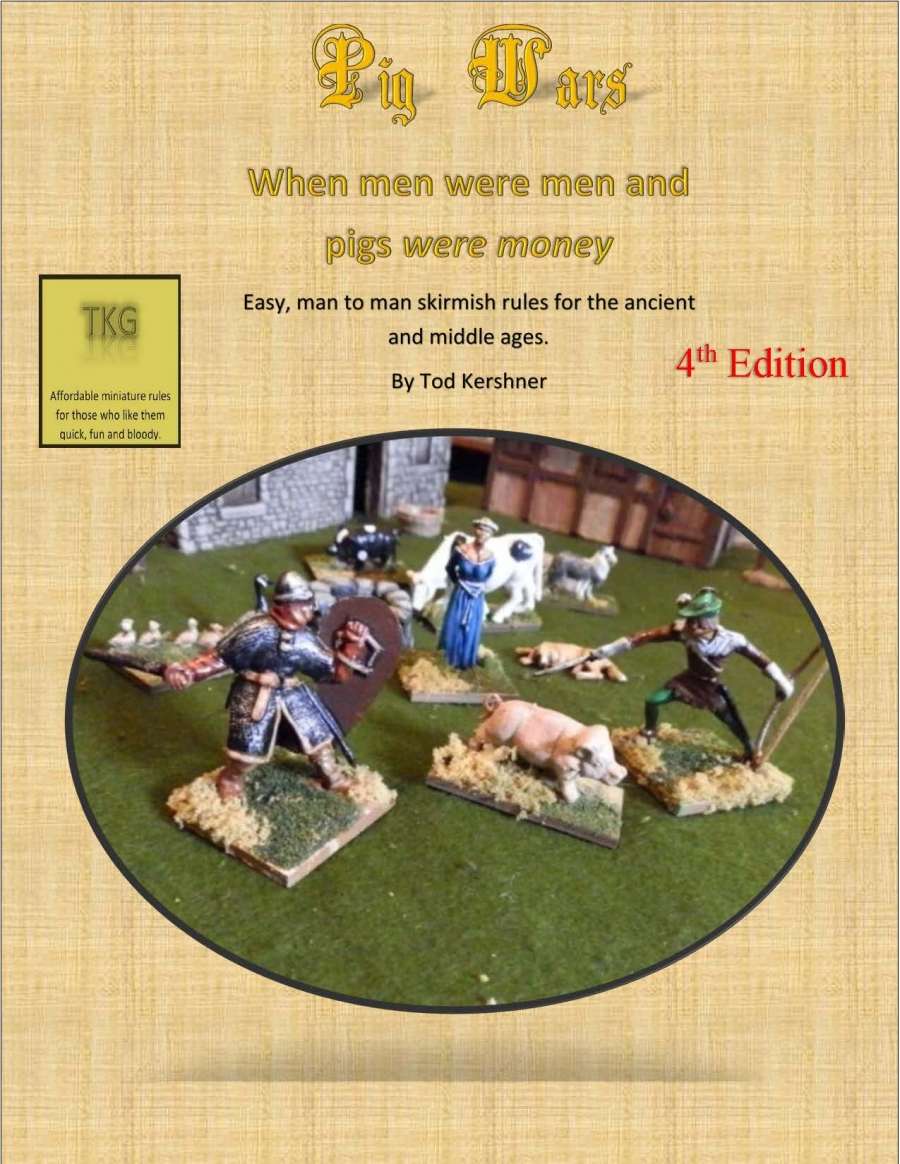
Pig Wars - Dark Ages Skirmish Rules Review
"When men were men, and pigs were... money."
This is an older (early 90s?) ruleset which is well recommended, but it used to be rather hard to order (one of those, join a yahoo group, learn a secret handshake, solve three riddles, each more fiendish than the last, and then ....) but anyway, it's now on Wargames Vault for download. Which is good.
I'm aware there are still miniatures companies who exist without online ordering facilities (sometimes grudgingly responding to an email) - and they continue to exist without my money (or cheque, or envelope of coins, barter or however they get their hard earned). I know, someone will say "that's how we did it in the old days" but wake up people, it's 2014, not 1964. Back in the old days I typed with a tough old typewriter that required 50-lb keystrokes, and also required me to use whiteout or rewrite the whole page if I misspelled a word. Should I be grateful if someone forced me to use it again instead of my PC? //rant
..anyway, where was I? Yes, Pig Wars. I was supposed to be reviewing it.
It seems to be designed for convention-style games where you have half a dozen different players controlling warbands in a battle. A gamesmaster is recommended. Yes, that's old-school.
The Shiny
Single column pdf. The main rules are on the first ~20 pages - the remaining 50 or so are scenario examples (with quite a lot of nice colour pictures of games in action), rules variations, and a bit of historical background. The Quick Reference Sheet has most of the relevant info and you could pretty much play off that.
Unit Classes
These are unarmoured, partially armoured (shield OR chainmail); or fully armoured (both). When attacked from the rear or unshielded side minis count as the armour class below. Morale goes from 0 (untrained) to 3 (elite/leader).
Initiative
A turn consists of:
1. Rally/Move
2. Shoot
3. Melee (mutual)
4. Morale checks
Pretty much IGOUGO, in other words.
Movement
Speed depends on armour. Difficult going slows you down, roads speed you up. The only thing out of the ordinary is that 3+ guys can form a "shield wall" which slows you up but is great for defence with significant bonuses. Charging adds +1d6"movement in a straight line, 40K style. Minis are based individually but stay within 12"of their standard. Skirmishers can "react"to a charge by withdrawing beyond range.
Shooting
Pig Wars uses playing cards, not dice. Draw cards to hit. For example, at close range all red suits hit, but at long range only diamonds hit. Players can attempt to "save" hits - i.e. an unarmoured figure saves on a Ace-10, and a fully armoured figure on a Ace-6.
Melee
Players add their morale (i.e. veteran = 2) plus weapon bonus (Charging, spear = 2) to a card (a "4"for example). If the player wins by a certain margin, he kills his enemy (i.e. 1 for unarmoured, up to 4 for fully armoured - and even more if in a shield wall.) Spearmen can fights in rows, and add their weapon bonuses to the front rank. Leaders get 3 wounds.
Morale
Units test when they take significant losses in a turn, or lose a leader/standard. If they fail to get a certain score they fall back from the nearest enemy or even rout entirely.
The Hold Card
Players can pick up one red face card/ace and keep it to play later for morale checks or leader melee, or for a leader to counter missile fire. It gives either a free "hit"or ""kill" to the leader. Basically, it is a "resource" heroes can spend. A lot like Might from LOTR;SBG. Jokers can be added in as extra hole cards with special effects like shooting bows twice.
Variations
There are rules variations for Roman games. Also rules for Greeks/Persians. It makes sense as both used a verson of the "shieldwall"tactic. In the bibliogtaphy I learned about the 1960s movies Alfred the Great and The Warlord which I'll now be hunting down.
There are also rules for 20 or so "Norn"cards that add heroic twists/traits such as a making a warrior "beloved of the gods" and allowing him to re-choose cards, being swift of foot, getting special armor etc. I'd definitely add these into my game as they add fun flavour.
There is also a late Medieval variant for the 100 Years War/War of the Roses. This adds the armour categories "partial plate"and "full plate" and relevant movement distances. There are no shieldwalls but troops can be "formed up" or in schiltron formations. Powerful longbows and crossbows are added, along with handguns that have a morale effect. There are even cannons.
TL:DR
The rules have aged well, but I don't see the point in using cards. In fact, the rules seem remarkably similar in feel to GW's LoTR:SBG (that's not a put-down, as I think they are rather good). Pig Wars doesn't offer anything over SAGA though as there is no campaign-progression system - which is why personally I'll continue to use a mod of LoTR rather than either rulebook. A solid but unspectacular set of rules which offers nothing different from the "usual"in terms of gameplay.
Recommended: Yes. Sound rules, even though I find the playing cards a bit unneccessary/gimmicky. However, I wouldn't bother if you already have a copy of LoTR:SBG as there are plenty of medieval/dark age house rules for it on the net for free, as well as campaign systems.
This is an older (early 90s?) ruleset which is well recommended, but it used to be rather hard to order (one of those, join a yahoo group, learn a secret handshake, solve three riddles, each more fiendish than the last, and then ....) but anyway, it's now on Wargames Vault for download. Which is good.
I'm aware there are still miniatures companies who exist without online ordering facilities (sometimes grudgingly responding to an email) - and they continue to exist without my money (or cheque, or envelope of coins, barter or however they get their hard earned). I know, someone will say "that's how we did it in the old days" but wake up people, it's 2014, not 1964. Back in the old days I typed with a tough old typewriter that required 50-lb keystrokes, and also required me to use whiteout or rewrite the whole page if I misspelled a word. Should I be grateful if someone forced me to use it again instead of my PC? //rant
Yes, there are tables in the game showing the best way to loot a pig...
..anyway, where was I? Yes, Pig Wars. I was supposed to be reviewing it.
It seems to be designed for convention-style games where you have half a dozen different players controlling warbands in a battle. A gamesmaster is recommended. Yes, that's old-school.
The Shiny
Single column pdf. The main rules are on the first ~20 pages - the remaining 50 or so are scenario examples (with quite a lot of nice colour pictures of games in action), rules variations, and a bit of historical background. The Quick Reference Sheet has most of the relevant info and you could pretty much play off that.
Unit Classes
These are unarmoured, partially armoured (shield OR chainmail); or fully armoured (both). When attacked from the rear or unshielded side minis count as the armour class below. Morale goes from 0 (untrained) to 3 (elite/leader).
Initiative
A turn consists of:
1. Rally/Move
2. Shoot
3. Melee (mutual)
4. Morale checks
Pretty much IGOUGO, in other words.
Movement
Speed depends on armour. Difficult going slows you down, roads speed you up. The only thing out of the ordinary is that 3+ guys can form a "shield wall" which slows you up but is great for defence with significant bonuses. Charging adds +1d6"movement in a straight line, 40K style. Minis are based individually but stay within 12"of their standard. Skirmishers can "react"to a charge by withdrawing beyond range.
Shooting
Pig Wars uses playing cards, not dice. Draw cards to hit. For example, at close range all red suits hit, but at long range only diamonds hit. Players can attempt to "save" hits - i.e. an unarmoured figure saves on a Ace-10, and a fully armoured figure on a Ace-6.
Melee
Players add their morale (i.e. veteran = 2) plus weapon bonus (Charging, spear = 2) to a card (a "4"for example). If the player wins by a certain margin, he kills his enemy (i.e. 1 for unarmoured, up to 4 for fully armoured - and even more if in a shield wall.) Spearmen can fights in rows, and add their weapon bonuses to the front rank. Leaders get 3 wounds.
Morale
Units test when they take significant losses in a turn, or lose a leader/standard. If they fail to get a certain score they fall back from the nearest enemy or even rout entirely.
The Hold Card
Players can pick up one red face card/ace and keep it to play later for morale checks or leader melee, or for a leader to counter missile fire. It gives either a free "hit"or ""kill" to the leader. Basically, it is a "resource" heroes can spend. A lot like Might from LOTR;SBG. Jokers can be added in as extra hole cards with special effects like shooting bows twice.
Variations
There are rules variations for Roman games. Also rules for Greeks/Persians. It makes sense as both used a verson of the "shieldwall"tactic. In the bibliogtaphy I learned about the 1960s movies Alfred the Great and The Warlord which I'll now be hunting down.
There are also rules for 20 or so "Norn"cards that add heroic twists/traits such as a making a warrior "beloved of the gods" and allowing him to re-choose cards, being swift of foot, getting special armor etc. I'd definitely add these into my game as they add fun flavour.
There is also a late Medieval variant for the 100 Years War/War of the Roses. This adds the armour categories "partial plate"and "full plate" and relevant movement distances. There are no shieldwalls but troops can be "formed up" or in schiltron formations. Powerful longbows and crossbows are added, along with handguns that have a morale effect. There are even cannons.
TL:DR
The rules have aged well, but I don't see the point in using cards. In fact, the rules seem remarkably similar in feel to GW's LoTR:SBG (that's not a put-down, as I think they are rather good). Pig Wars doesn't offer anything over SAGA though as there is no campaign-progression system - which is why personally I'll continue to use a mod of LoTR rather than either rulebook. A solid but unspectacular set of rules which offers nothing different from the "usual"in terms of gameplay.
Recommended: Yes. Sound rules, even though I find the playing cards a bit unneccessary/gimmicky. However, I wouldn't bother if you already have a copy of LoTR:SBG as there are plenty of medieval/dark age house rules for it on the net for free, as well as campaign systems.
5 Parsecs from Home Review (Supplement to 5Core Skirmish Gaming System)
This can be seen as a continuation of my 5Core skirmish rules review. My two main concerns about 5Core were the absence of troop quality and the somewhat bare bones nature of the rules. Weighing in at 91 pages this “supplement” is actually 4x bulkier than the parent system, so fleshing things out shouldn't be an issue.
Fluff
The setting has a bit of a “Firefly” vibe (a good thing, for me, anyway) with most campaigns occurring in outlaw "fringe" space away from the all-powerful Unity government.
Crew/Unit Creation
You start with a few heroes and a handful of goons – about 5-6 minis and no more than 8 to start. Character creation is very RPG-y. There are d100 tables where you can randomly create the planet of origin, motivations, class and special skills of characters – most of which are “background” and have no impact on actual gameplay. There are about 40+ “talents” or special skills, 20+ flaws, and 20+ of alien traits. At the end of my 5Core review I somewhat wryly said there would doubtless be "80 special skills and abilities to make up for the lack of stats" - amusingly it looks like I hit the nail right on the head!
There is also a range of ~20 psychic powers. Heck, you can even randomly generate the spaceship you fly around in, friendships and rivalries and how you met your creew - if that isn't Firefly I don't know what is. There is no "points system" and this campaign system is definitely not even remotely designed for the competitive club scene - its more for playing with casual mates/RPGers than the local 40K rules lawyers.
Campaign
You can see clearly how 5 Parsecs is aimed at the zone between skirmish wargames and RPGs (an area dominated by Two Hour Wargame titles in recent years). It is not a good competitive system and could be easily abused. The campaign, like the unit creation, is very much about making a story.
You can roll on tables to find a patron and get a job. Your crew can trade and acquire items and see the sights. You can track down enemies and random campaign events or random character events can complicate matters . Your characters can gain new skills and traits and you can recruit new crewmembers. Finishing missions gets you rolls on the loot table. There are tables for generating encounters, and opponents, and even their weapons. If the mission involves destroying or capturing a target, you can even have a table for what sort of target it was.
Basically, this is a RPG, with more tables (20 pages worth?) than you can shake a stick at - without getting a sore arm, anyway. It has more tables and stuff to do than Mordhiem, but it's not aimed at the same niche - 5 Parsecs is about generating a story. There are even tables to tell what tables to roll on (OK, I made that up). Suffice to say, there is a lot you can do on a campaign, though none of it would be "balanced" for competitive gameplay in the slightest. There are even some Gamemaster tools for travel and player actions, and reactions by NPCs. You'll like it if you like RPGs like Savage Worlds, THW: 5150 or Song of Blades campaigns (< though SoBH has a much sketchier campaign system) - but it is not the new Necromunda* (*On a side note, the person who does make the "new Necromunda" is going to make a mint.)
Scenario Rules
These are extra rules to add onto the base 5Core system for scenarios such as hacking, bluffing/persuading, doing field repairs, NPC reactions, climbing, falling and blasting open doors.
Weapons & Gear
The weapons section gives more detail on a good range of weapons - blasters and slug throwers, electric guns, flamers - that covers most sci fi situations. There's flak, combat and power armour, and a range of melee weapons. Sentry guns, portable shields and teleporters, jump belts. In short, a goodly selection allowing you to cover most sci-fi situations. Like the base 5Core system, it does a solid job of giving a range of weapons using rather limited rules and modifiers.
GZG's 15mm "Free Trader"pack reminds me of a certain crew....
TL:DR
Five Parsecs from Home is a RPG lite - a campaign allowing you to take a bunch of minis on adventures. Firefly-style adventures at that. It does not fill the Necromunda void of warband v warband combat, but is more like a friendly version of the old Rogue Traderwhere wargaming and RPGs get hazy. Two Hour Wargames has already filled this niche with its 5150 sci fi series but Five Parsecs gives it some much-needed competition. Like 5150, 5 Parsecs focusses more on what is happening before and after the game, rather than the game itself. I'd say 5 Parasecs is superior as a campaign-story-generator, as it has more campaign options and "tools" and provides faster, more accessible gameplay once you get minis on the table.
Recommended? Yes. If you're after a story-based skirmish campaign with a RPG feel but simple combat rules, 5 Parsecs delivers. Whilst it does have the 80+ special rules I predicted, it fleshes out the 5Core system and gives you a good toolbox for making space adventures with whatever cool sci fi minis you've got laying around. Personally, I think it should have the 5Core rules included within the 5Parsecs supplement, but there is a discounted "bundle" you can buy on the Wargames Vault.
Traitor's Blade - Sebastian de Castell
Quite a few people have likened this to "Dumas meets Abercrombie" but I'd say it's closer to "Dumas meets Gemmell" - though I'm not sure which is a bigger compliment.
Basically, its a gritty fantasy Three Musketeers (there are even three main characters) following heroes who were once Greatcoaks, basically travelling magistrates-come-swordmasters who dispensed the king's justice in the corrupt dukedoms.
That was in the past. Now theMusketeers Greatcoats are reviled as traitors, cowards who let their king die. Distrusted by the avaricious, grasping usurper Dukes, they live as sell-swords - and when the story begins, they have just been framed for murder. The novel follows the leader of the Greatcoats, Falcio val Monde, both in the current timeline, and in telling the story of how the Greatcoats came to be.
The story had witty swashbuckler-style banter, and Joe Abercrombie-style quotable lines:
"The first rule of the sword - put the pointy end in the other man"
It's fantasy, but magic doesn't play a major role. There's some sorts of paralysing powers used by ninja-style assassins, fae horses (which I did find a bit jarring) and the odd bit of prophecy. I was a bit annoyed by said magic horse, the healing prostitute/nun. Some of the young noblewomen were a bit precocious and a torturer started speaking like Tarzan. But in a book where 6 to 1 swordfights are the norm, I might be being a bit picky. But there are demented evil villainesses, transcended sword saints, nude female assassins, duplicitous villains, fisticuffs and, of course, swashbuckling. With rapiers. Lots of it.
This book is fun. Whilst there are sad and dark moments, it's fun without being silly. Fun in the style of Retribution Falls. The best debut novel I've read since Name of the Wind or the Musashi coming-of-age story Child of Vengeance. If you'd like a more modern Three Musketeers, this Is thedroid book you've been waiting for.
Basically, its a gritty fantasy Three Musketeers (there are even three main characters) following heroes who were once Greatcoaks, basically travelling magistrates-come-swordmasters who dispensed the king's justice in the corrupt dukedoms.
For some reason the cover reminds me of the videogame Dragon Age.
That was in the past. Now the
The story had witty swashbuckler-style banter, and Joe Abercrombie-style quotable lines:
"The first rule of the sword - put the pointy end in the other man"
It's fantasy, but magic doesn't play a major role. There's some sorts of paralysing powers used by ninja-style assassins, fae horses (which I did find a bit jarring) and the odd bit of prophecy. I was a bit annoyed by said magic horse, the healing prostitute/nun. Some of the young noblewomen were a bit precocious and a torturer started speaking like Tarzan. But in a book where 6 to 1 swordfights are the norm, I might be being a bit picky. But there are demented evil villainesses, transcended sword saints, nude female assassins, duplicitous villains, fisticuffs and, of course, swashbuckling. With rapiers. Lots of it.
This book is fun. Whilst there are sad and dark moments, it's fun without being silly. Fun in the style of Retribution Falls. The best debut novel I've read since Name of the Wind or the Musashi coming-of-age story Child of Vengeance. If you'd like a more modern Three Musketeers, this Is the
Langganan:
Postingan (Atom)