This post was prompted by the new Chain of Command spin-off Fighting Season. Since CoC is the Lardies best and most polished ruleset ever, with some great innovations, I should be more excited. But I'm not. But it isn't the rules that are a problem.
It isn't the minis. Some of the modern stuff is really great. Empress, Red Star and Eureka make great 28mms. The former two have amazing detail and production quality. S&S have 20mm that tempt me to try a new scale. And every 15mm manufacturer worth their salt has tipped their toes in at least, though QRF and Peter Pig are the dominant players. I want a reason to buy more modern soldiers.
I want to buy modern minis. I want to use them. But I really don't want to play Afghanistan or Iraq. Again. Modern skirmish or platoon level gaming is rapidly becoming as crowded as WW2 platoon level or hard sci fi "Vietnam-on-Space." I'm tired of insurgents/freedom fighters/terrorists. I'm tired of sand and Middle Eastern terrain.
So here's what I'd like to play with my modern soldiers....
Well, besides modern psychic/horror (psychic powers ftw! ...and yes you can have Cthulhu if you insist), X-COM (if only we had decent minis); Alien Invasion (Battle for Los Angeles) and Stargate. I think gabbed on these topics a bit already. But besides this? Wait for it.....
Hollow Earth
Yes, why should 1930s pulp heroes get all the fun? If you want to avoid corny giant gorillas and dinosaurs, maybe make it reptilian aliens or demons for a grittier feel. You know the things mankind has feared for centuries, that make up the stuff of our darkest legends and myths? They're real, and they live beneath us. Dig out your random monster minis, people! Also, the underground nature would be a good reason to focus on small scale infantry combat, and make for fun terrain. Maybe unexplored civilizations lie 40,000ft beneath our feet.... Perhaps also renegade Nazis who burrowed too deep from their Antarctica base when fleeing Admiral Baird's expedition....
Hebrew Mythology
Yes, this is a bit of a weird one. But Hebrew myth (and part of the Catholic Apocrytha) allude to the "Fallen" - 200-odd angels sent to guide mankind but who got too involved in human affairs. Hence "the" Flood which was primarily to exterminate them. This would be a nice change from Vampires/Werewolves but with similar gameplay effects. It has a basis for a faith/magic system and premade (but not too familiar) fluff. Fallen could fall into good/evil/neutral camps and would have human followers (or even organisations, like Opus Dei or MJ12). They could be opposed by "Demons" - incorporeal beings who control humans like puppets. More powerful demons could split themselves to control several humans - or give a single human superhuman abilities. If a possessed human is killed it proportionately weakens the demonic entity. Demonic gameplay could give an asymetrical feel and involves resource management. Humans would be weaker, but rare individuals could possess more "Faith" making them meatshields or powerful glasscannon mages. And perhaps add Nephilim- half human/angel hybrids from Nazi experiments in the war. Also, golems.
Anyway, back later. I'm off to glue a flaming sword onto the back of my 28mm US Special forces....
Tampilkan postingan dengan label Modern. Tampilkan semua postingan
Tampilkan postingan dengan label Modern. Tampilkan semua postingan
Jumat, 10 April 2015

Sabtu, 13 Desember 2014
FiveCore Skirmish Gaming Review
This game system (and its various permutations) has been sitting atop the Wargames Vault bestsellers for a while, so I thought I'd check it out. This is the "basic"system based on modern warfare, but there already are a swarm of supplements.
The Shiny:
There isn't any. My $5 pdf is easy enough to read but looks like it was written in MS Word. In fact the whole rules are pretty brief - so much so I was a bit concerned lest I accidentally publish the complete rules system when reviewing it.

Gameplay:
Each player takes a turn. However, there is a twist - a d6 is rolled before you activate any of your minis. A "1" (Scurry) means your forces can move and not fire; however they are immune to overwatch fire. On a "6" (Firefight) your forces can fire but not move. A 2-5 means you have a normal move - you can activate 2 of your minis (or 3 minis if you are using a big squad of 8+) and move/fire.
Movement is the usual 6" and can be impeded by the usual rough/difficult ground and obstacles.
Combat
Players roll two sorts of dice - a Shock dice and a Kill dice. Again the key rolls are "1" and "6". On Kill dice 1s and 6s knock down or take targets out of action. On Shock dice targets can flinch (take cover) or bail (flee). Minis who have not fired in their last turn can react and put down suppressive fire (Shock dice only) on targets that move into LoS.
Melee is simply both roll d6, highest wins and knocks out their enemy (with a few simple modifiers).
Weapons & Equipment
Normal modern weapons - from assault rifles, pistols, grenades, sniper rifles and LMGs etc - are all covered. Short range weapons like pistols and SMGs fire 12" - the rest work to LoS. The guns have some good "character" that fits their role well - a LMG can fire lots of Shock dice in a suppressive role. Sniper rifles get extra Kill dice and cause friendlies near the target to flinch.

Recommended: If you liked the minimalist approach of Song of Blades and don't mind paying for a somewhat bare bone ruleset with minimal production values, then yes. It's quite a nifty little system, and I think it will gain a cult following amongst a certain type of gamer.
Personally, there are a few things have me holding back my enthusiasm:
#1. the system itself is so short it should be simply be included within any "setting" or "campaign" it came with rather than sold separately. It's just a Word doc.
#2. I think troop skill/training is very important, and the rules do not reflect this enough
#3. I'm not a fan of using a squillion special rules/traits/abilities just because the designer was trying to be trendy and eschew stats. I think it's false economy - it's actually easier to remember 3-5 stats universal to everyone, than the extra 80 special rules you need to do the same job i.e. differentiate between the minis. No, there isn't 80 special rules... yet - but I'd put 10:1 odds on the "supplements" adding bucketloads.
EDIT: I've just obtained the 5 Parasecs from Home sci fi supplement, so we'll see if this addresses any issues I have... stay posted for a follow-up review... and here it is.
The Shiny:
There isn't any. My $5 pdf is easy enough to read but looks like it was written in MS Word. In fact the whole rules are pretty brief - so much so I was a bit concerned lest I accidentally publish the complete rules system when reviewing it.
5Core has some interesting ideas with regards to action and weapons fire. It will appeal to the minimalist Song of Blades crowd and is great for getting minis on the table for a quick game.
Gameplay:
Each player takes a turn. However, there is a twist - a d6 is rolled before you activate any of your minis. A "1" (Scurry) means your forces can move and not fire; however they are immune to overwatch fire. On a "6" (Firefight) your forces can fire but not move. A 2-5 means you have a normal move - you can activate 2 of your minis (or 3 minis if you are using a big squad of 8+) and move/fire.
Movement is the usual 6" and can be impeded by the usual rough/difficult ground and obstacles.
Combat
Players roll two sorts of dice - a Shock dice and a Kill dice. Again the key rolls are "1" and "6". On Kill dice 1s and 6s knock down or take targets out of action. On Shock dice targets can flinch (take cover) or bail (flee). Minis who have not fired in their last turn can react and put down suppressive fire (Shock dice only) on targets that move into LoS.
Melee is simply both roll d6, highest wins and knocks out their enemy (with a few simple modifiers).
Weapons & Equipment
Normal modern weapons - from assault rifles, pistols, grenades, sniper rifles and LMGs etc - are all covered. Short range weapons like pistols and SMGs fire 12" - the rest work to LoS. The guns have some good "character" that fits their role well - a LMG can fire lots of Shock dice in a suppressive role. Sniper rifles get extra Kill dice and cause friendlies near the target to flinch.
5Core's basic system is aimed at modern warfare, but lack of troop quality is an issue for me. Eureka has some great modern figures - here are some USMC models from their gallery.
Extra Rules
There are extra rules for “unusual situations” such as info gathering and searching for items)such as weapons caches) . Completing tasks uses the same 1-and-6 system – a ‘1’ delays, and a ‘6’ means someone else has to try. There is rules for calling in indirect fire, and some welcome solo gaming guidelines – again there is a simple dice system and troops can dig in or push forward recklessly.
I do like the rules for advancement and casualties – troops can miss games or die outrigjht, and there are about 20 skills that give simple boosts or extra dice when shooting, moving etc.
TL:DR
The aim was for a simple game, with no stats at all (not stats can be good or bad, depending on how you view it) and plenty of unpredictably. It has interesting activation and weapon mechanics. It was to be a skeleton system to hang campaigns and create stories. I think the game designer has achieved his goals quite well. The popular rules-lite Song of Bladesengine falls down in “shooty” settings so 5Core fills this gap nicely. This is a game where you can jump straight in and get playing and would make a great introductory game for friends – it’s super easy to learn and you only need a 2x2 or 4x4ft table and a handful of minis each side.
Recommended: If you liked the minimalist approach of Song of Blades and don't mind paying for a somewhat bare bone ruleset with minimal production values, then yes. It's quite a nifty little system, and I think it will gain a cult following amongst a certain type of gamer.
Personally, there are a few things have me holding back my enthusiasm:
#1. the system itself is so short it should be simply be included within any "setting" or "campaign" it came with rather than sold separately. It's just a Word doc.
#2. I think troop skill/training is very important, and the rules do not reflect this enough
#3. I'm not a fan of using a squillion special rules/traits/abilities just because the designer was trying to be trendy and eschew stats. I think it's false economy - it's actually easier to remember 3-5 stats universal to everyone, than the extra 80 special rules you need to do the same job i.e. differentiate between the minis. No, there isn't 80 special rules... yet - but I'd put 10:1 odds on the "supplements" adding bucketloads.
EDIT: I've just obtained the 5 Parasecs from Home sci fi supplement, so we'll see if this addresses any issues I have... stay posted for a follow-up review... and here it is.
Rabu, 18 Desember 2013
Bulldogs Away! Naval Rules Review (Modern Fast Attack Craft)
Modern naval wargames bore me. Not that they are all overcomplicated - for example "Shipwreck" is a pretty good game that covers all the key areas without tedious rivet counting.
But it's the scale and speeds involved that turns me off. The vast ranges involved make maneuver almost redundant. I could pretty much play a modern naval game without miniatures at all. When your 30-knot destroyer is pretty much motionless relative to a 450-knot missile, which can accurately range beyond 60 miles, it's evident that "maneuver" very much takes a back seat to spotting and shooting. Most of the time a player's most exciting decision is "do I turn on my active radar or not."
However fast attack craft are a different story. They tend to be employed in coastal waters where over-the-horizon attacks are uncommon. They also tend to be often in action - small patrol boats and fast attack craft are involved in the majority of post-WW2 surface actions - numerous North/South Korean gunboat clashes (1st Battle of Yeonpyeong, 2nd Battle of Yeonpyeong, )
the Iran-Iraq war, the Indo-Pakistan Wars (Operation Trident, and Operation Python) and the Middle Easy (Latakia and Baltim) as well as China vs North Korea's corvette gun battle in the 1974 Battle of Hoang Sa)
I noticed that very few involved aircraft, and all FAC battles were in visual range (The 1st Battle of Yeonpyeong started with gunboats "bumping" each other!) with maximum ranges of 15-20 miles for missile fire. In most cases, close range automatic gunfire was the main weapon. Very few post-WW2 surface battles involved more than one or two small corvettes or frigates - in fact the majority of combatants were usually - you guessed it - fast attack craft under 250 tons. And interestingly enough, there is a set of rules aimed specifically at these modern fast attack craft.

The "Osa" class and its variants have probably seen more action than any other post-war vessel. The Indian variants sank most of the Pakistani navy... ..and the Israelis sank a bunch of them in the Middle East...
Stats & Ship Data Cards
Ships can have different crew quality - and each side has an overall command quality - which modifies dice rolls. Ship "data" is not too complicated...
Size - Damage Modifier (hull toughness) - Speed - Maneuverability
Fire Control - Electro Optics - ESM - ECM - Decoys - Weapons (usually only 3-4 systems)
...and can be recorded rather easily compared to most naval games.
Initiative/Play Sequence
Ships roll a d6 (adjusted for command quality) and leave it beside the model. This determines the order for moving and firing. The sequence of play goes:
Aircraft
Ships
Torpedoes
Aircraft (2nd move)
Spotting
Launch flares/chaff
Launch SAMS
Snap fire missiles and torpedoes
Fire guns
Resolve missiles and guns fired the previous turn
Launch missiles and torpedoes (normal)
Damage Control

Vessels can travel at speeds from creep (5cm) to very fast (30cm) - which is 40kts+. Speeds can only be changed by 2 levels per turn so you'll need someway to record this. Turning is similar to many aircraft games - you must move x amount of distance before you can perform a 60d turn. There are rules for collisions, drifting, running aground and towing.
Detection
Undetected ships can be replaced with two counters ("blips") - one can be a dummy. Blips can only make spotting attempts if they are revealed to be a real ship, at which point they are replaced with a different marker and become a "contact." One other dummy counter must be removed. Contacts may make spotting attempts, but may not fire. In order to fire, the contact must be replaced by a model on the table (thus becoming a target itself.) Blips and contacts can move like the ships they represent.
Extreme radar detection range is about 110cm for a "Osa" in normal circumstances. This can increase or decrease significantly based on circumstances. At up to half range, detection is automatic - beyond that, a dice roll must be made. Ships using passive ESM can detect ships using active radar at greater distances, but may not attack unless they have very advanced radar. Visual spotting is much closer - about 60cm but can be drastically modified by weather or darkness.
Countermeasures & Decoys
These offer a d6 "saving throw" against missile types they are designed to defeat.
Weapons Fire
These must exceed a "target number" on a d20. There is quite a lot of modifiers for both guns and missiles - you'd need the chart to remember them all. "Snap fire" allows missiles to be fired earlier in the turn sequence but they have a significant negative modifier.
Torpedoes and missile fire are resolved in the following turn (torpedoes can "run" for several turns) which necessitates recording their targets in some way. Usually ships can only fire one at a time which means the board should not get too cluttered.
With an average 40-57mm automatic gun reaching to 30cm, and missiles having a minimum range (30-75cm for a Styx SS-N-2, for example) maneuver is quite important, and with most boats having a 25cm+ top speed it is quite easy to close or open the range. Yay!

Damage
Hits roll 2 d10 - one for the "damage level" (or structural integrity) which ranges from intact, to damaged-heavily damaged-wrecked-sunk. Each level impacts on speed and maneuverability.
Damaging hits cause a roll to be made for each ship system to see if it is knocked out. The other d10 shows "special hits" or "criticals" such as power loss or fires.
This is a pretty restrained system compared to the usual naval wargames rivet-counting and works fine given the small number of ships (no more than a dozen) involved in the "average" fight.
Aircraft & Helicopters
These get two "movement phases" although aircraft maneuver is pretty limited on the battlefield and there are rules for air to surface and surface to air combat.
Miscellaneous Rules
There are rules for more unconventional craft such as hovercraft, hydrofoils and "ground effect" craft. Others include mines and minesweeping as well as landing forces and shore bombardment - both of which would come in handy for scenarios. Since FAC doctrine emphasizes combat amongst islands and cluttered terrain, there is a random "terrain generator" for those who need inspiration in setting up a table.
 The Italian "Sparviero" hydrofoils seem ridiculously heavily armed for their size. Can't help imagining what would happen if they took a hit and "crashed" off their foils at high speed. Well, Bulldogs Away covers that eventuality....
TL:DR
+ Has all important details, but avoids the heavy rivet-counting that plagues many naval games
+ Maneuver, firing and spotting is "balanced" and fun compared to "normal" modern naval games
+ Focus on ships that actually fought numerous post-War battles as opposed to Cold War "what ifs"
+ Extensive ship and equipment lists
+ Straightforward detection rules allow for a bit of "hide and seek"
- quite a few modifiers, no QRS (perhaps one is available on a yahoo group?)
- need to track speed, missiles & torpedoes fired, and each ship's initiative either clutters the board or is annoying to have to record
Bear in mind this is a largely "unplaytested" review (except for pushing a bunch of WW2 E-boat "proxies" around briefly to experiment with some rules mechanisms)
Recommended?: Well, the rules themselves, yes.
My main issue personally, is that modern naval FAC miniatures are a niche within a niche, so you have limited choice within scales. At 1:700 you have PT Dockyard and Skytrex but I object to paying $8+ for single small model, for a game where I know I'll have to buy both forces. At smaller scales you have 1:1200 North Head (Shapeways, and as expensive as 1:700), 1:3000 Denian (there is no website but you can see the catalogue via yahoo groups) and 1:2400 Viking Forge (no option for online payment - send a cheque? Really?) There are various Shapeways options if you hunt around, but none are reasonably priced. All the ranges are rather sketchy and incomplete - and the one range that is likely to expand - PT Dockyard - lacks modern support ships (merchants, etc) in 1:700.
In short - good rules, cool battles - but limited model choices are a major drawback.
But it's the scale and speeds involved that turns me off. The vast ranges involved make maneuver almost redundant. I could pretty much play a modern naval game without miniatures at all. When your 30-knot destroyer is pretty much motionless relative to a 450-knot missile, which can accurately range beyond 60 miles, it's evident that "maneuver" very much takes a back seat to spotting and shooting. Most of the time a player's most exciting decision is "do I turn on my active radar or not."
However fast attack craft are a different story. They tend to be employed in coastal waters where over-the-horizon attacks are uncommon. They also tend to be often in action - small patrol boats and fast attack craft are involved in the majority of post-WW2 surface actions - numerous North/South Korean gunboat clashes (1st Battle of Yeonpyeong, 2nd Battle of Yeonpyeong, )
the Iran-Iraq war, the Indo-Pakistan Wars (Operation Trident, and Operation Python) and the Middle Easy (Latakia and Baltim) as well as China vs North Korea's corvette gun battle in the 1974 Battle of Hoang Sa)
I noticed that very few involved aircraft, and all FAC battles were in visual range (The 1st Battle of Yeonpyeong started with gunboats "bumping" each other!) with maximum ranges of 15-20 miles for missile fire. In most cases, close range automatic gunfire was the main weapon. Very few post-WW2 surface battles involved more than one or two small corvettes or frigates - in fact the majority of combatants were usually - you guessed it - fast attack craft under 250 tons. And interestingly enough, there is a set of rules aimed specifically at these modern fast attack craft.
The "Osa" class and its variants have probably seen more action than any other post-war vessel. The Indian variants sank most of the Pakistani navy... ..and the Israelis sank a bunch of them in the Middle East...
Bulldogs Away
...is a 38-page black and white pdf. The rules themselves are only 21 pages. The other 17 is a rather thorough list of various missiles, bombs, guns, helicopters, aircraft and ships. There is a thorough index but no "quick reference" sheet. The pdf is plain text throughout - no "bells and whistles" here.Stats & Ship Data Cards
Ships can have different crew quality - and each side has an overall command quality - which modifies dice rolls. Ship "data" is not too complicated...
Size - Damage Modifier (hull toughness) - Speed - Maneuverability
Fire Control - Electro Optics - ESM - ECM - Decoys - Weapons (usually only 3-4 systems)
...and can be recorded rather easily compared to most naval games.
Initiative/Play Sequence
Ships roll a d6 (adjusted for command quality) and leave it beside the model. This determines the order for moving and firing. The sequence of play goes:
Aircraft
Ships
Torpedoes
Aircraft (2nd move)
Spotting
Launch flares/chaff
Launch SAMS
Snap fire missiles and torpedoes
Fire guns
Resolve missiles and guns fired the previous turn
Launch missiles and torpedoes (normal)
Damage Control

A "Sa'ar" missile boat firing a Gabriel
(source: Zahal.org)
MovementVessels can travel at speeds from creep (5cm) to very fast (30cm) - which is 40kts+. Speeds can only be changed by 2 levels per turn so you'll need someway to record this. Turning is similar to many aircraft games - you must move x amount of distance before you can perform a 60d turn. There are rules for collisions, drifting, running aground and towing.
Detection
Undetected ships can be replaced with two counters ("blips") - one can be a dummy. Blips can only make spotting attempts if they are revealed to be a real ship, at which point they are replaced with a different marker and become a "contact." One other dummy counter must be removed. Contacts may make spotting attempts, but may not fire. In order to fire, the contact must be replaced by a model on the table (thus becoming a target itself.) Blips and contacts can move like the ships they represent.
Extreme radar detection range is about 110cm for a "Osa" in normal circumstances. This can increase or decrease significantly based on circumstances. At up to half range, detection is automatic - beyond that, a dice roll must be made. Ships using passive ESM can detect ships using active radar at greater distances, but may not attack unless they have very advanced radar. Visual spotting is much closer - about 60cm but can be drastically modified by weather or darkness.
Countermeasures & Decoys
These offer a d6 "saving throw" against missile types they are designed to defeat.
Weapons Fire
These must exceed a "target number" on a d20. There is quite a lot of modifiers for both guns and missiles - you'd need the chart to remember them all. "Snap fire" allows missiles to be fired earlier in the turn sequence but they have a significant negative modifier.
Torpedoes and missile fire are resolved in the following turn (torpedoes can "run" for several turns) which necessitates recording their targets in some way. Usually ships can only fire one at a time which means the board should not get too cluttered.
With an average 40-57mm automatic gun reaching to 30cm, and missiles having a minimum range (30-75cm for a Styx SS-N-2, for example) maneuver is quite important, and with most boats having a 25cm+ top speed it is quite easy to close or open the range. Yay!
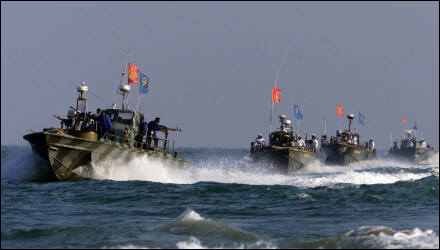
Sea Tiger insurgents - fought against the Sri Lankan navy in armed speedboats.
"Bulldogs Away" allows even small armed whalers and jetskis to be included
Damage
Hits roll 2 d10 - one for the "damage level" (or structural integrity) which ranges from intact, to damaged-heavily damaged-wrecked-sunk. Each level impacts on speed and maneuverability.
Damaging hits cause a roll to be made for each ship system to see if it is knocked out. The other d10 shows "special hits" or "criticals" such as power loss or fires.
This is a pretty restrained system compared to the usual naval wargames rivet-counting and works fine given the small number of ships (no more than a dozen) involved in the "average" fight.
Aircraft & Helicopters
These get two "movement phases" although aircraft maneuver is pretty limited on the battlefield and there are rules for air to surface and surface to air combat.
Miscellaneous Rules
There are rules for more unconventional craft such as hovercraft, hydrofoils and "ground effect" craft. Others include mines and minesweeping as well as landing forces and shore bombardment - both of which would come in handy for scenarios. Since FAC doctrine emphasizes combat amongst islands and cluttered terrain, there is a random "terrain generator" for those who need inspiration in setting up a table.

TL:DR
+ Has all important details, but avoids the heavy rivet-counting that plagues many naval games
+ Maneuver, firing and spotting is "balanced" and fun compared to "normal" modern naval games
+ Focus on ships that actually fought numerous post-War battles as opposed to Cold War "what ifs"
+ Extensive ship and equipment lists
+ Straightforward detection rules allow for a bit of "hide and seek"
- quite a few modifiers, no QRS (perhaps one is available on a yahoo group?)
- need to track speed, missiles & torpedoes fired, and each ship's initiative either clutters the board or is annoying to have to record
Bear in mind this is a largely "unplaytested" review (except for pushing a bunch of WW2 E-boat "proxies" around briefly to experiment with some rules mechanisms)
Recommended?: Well, the rules themselves, yes.
My main issue personally, is that modern naval FAC miniatures are a niche within a niche, so you have limited choice within scales. At 1:700 you have PT Dockyard and Skytrex but I object to paying $8+ for single small model, for a game where I know I'll have to buy both forces. At smaller scales you have 1:1200 North Head (Shapeways, and as expensive as 1:700), 1:3000 Denian (there is no website but you can see the catalogue via yahoo groups) and 1:2400 Viking Forge (no option for online payment - send a cheque? Really?) There are various Shapeways options if you hunt around, but none are reasonably priced. All the ranges are rather sketchy and incomplete - and the one range that is likely to expand - PT Dockyard - lacks modern support ships (merchants, etc) in 1:700.
In short - good rules, cool battles - but limited model choices are a major drawback.
Selasa, 01 Oktober 2013
Oil Rig - Cheap & Nasty Scratchbuilt Terrain
Here's my next 30 minute project. It was just random balsa pieces put on top a piece of precut MDF (I think they are meant to be drink coasters but they are very handy for terrain bases).
The rig "legs" were black plastic piping for sprinkler systems.
 I had spare time so I thought I'd paint on a bit of detail and stay under my 30 minute limit.
Kinda regret I did though - it looks rather cartoon-y. Also making the helipad so garishly obvious precludes the use of the rig for VSF aeronef gaming...
 The jets are Tumbling Dice 1:600 and are always a pleasure to paint.
 I've got plans for the oil rig for an alternate-future 1970s which involves aerial wormholes, resource-rich planets and mercenary air forces. Think Area 88 meets Yukikaze.
The rig "legs" were black plastic piping for sprinkler systems.

Kinda regret I did though - it looks rather cartoon-y. Also making the helipad so garishly obvious precludes the use of the rig for VSF aeronef gaming...


Yukikaze had wormholes that appeared over Antarctica. They lead through to an alien planet which humanity invades through the wormhole. Lots of cool dogfights. Weird incomprehensible plot.
Area 88 has a mercenary air force fighting in some un-named African/Middle Eastern country. Awesome 1970s dogfights with an annoyingly angsty, whiny, Japanese teen protagonist.
Sabtu, 16 Februari 2013
Battlestations! Battlestations! WW2 Naval Fleet Combat Rules Reviewed
Whilst looking for a good aeronef/flying battleship game I have been digging through naval rules to see what is worth converting.
An obvious contender is General Quarters, so long the benchmark in naval gaming. Whilst the original GQ were revolutionary in how they simplified and abstracted naval warfare, in a way both playable and realistic, I feel General Quarters 3 has swung the pendulum back too far in the direction of complexity and "rivet counting" with extra hitboxes and hit locations, and salvoes swapped for individual weapon mounts.
So are there any naval games out there that emphasize playability and the ability to handle decent numbers of ships? Naval Thunder is a little simpler in its mechanics, but I feel less accurate and comes with plenty of book-keeping and hitboxes (I'm talking 100+ hull points for battleships). No advantage there.
So I tried a lesser-known title. Battlestations! promises "streamlined intuitive game system with a focus on tactics rather than minutiae" and "handle 30 ships in under 3 hours" and "markers to eliminate the necessity of book-keeping." Sold!

The Shiny
Battlestations! is rather old school in its layout with rather small unfriendly font and only a smattering of photos and illustrations. B&W with a colour softcover, it has the SFB-style layout, with dense wall of text and small, tight font. However it does supply all the cardboard tokens and markers you need to play which is an old-school touch I do appreciate. There are not only quick-reference charts in the back of the book, but they are even duplicated in cardstock. No photocopying required. Of 81 pages, the rules take only 21.
Mechanics
There is no paper record keeping (!) only markers - for speed (full, medium, slow, dead stop); damage (levels 1 through 4); and torpedoes expended. There is a clear scale (1" = 1000 yards, 1 turn = 30 minutes) and d20, surprisingly, are used.
Players dice for initiative (+/- fleet commander ratings) to determine move order which is IGOUGO.
Random weather is rolled for, and players can roll to detect opponents. Radar helps of course.
Ships can change speed modes by one level (i.e. slow to medium) per turn, and there are rules for reversing, collisions, ramming and running aground. Turn templates are provided. Weather can impact movement - for example smaller ships labour in heavy seas. There are submarine rules (subs can travel underwater at 4 depth levels).
Movement is pretty standard, but firing and damage is quite different. Weapon penetration and armour levels (both rated A-E) are compared; gun may only attack targets 1 level higher than themselves.
Overall "attack" and "defence" scores are compared, rather like General Quarters. This is referenced on a chart and a d20 roll is made. Torpedo rules are likewise pretty simple.
Shots can miss, do a single "damage level" (of which a ship has four) or do a critical which could do 2-4 levels or automatically sink the ship.

Damage is four levels -
L1 - with little adverse effects on capabilities
L2 - armament reduced by 1/3rd and ship restricted to medium speed; sonar and radar knocked out.
L3 - armament reduced by 2/3rds, ships restricted to slow speed; carriers cannot launch or recover
L4 - everything knocked out, ship dead in the water
Damage can exceed level 4 - as Damage Repair is quite powerful. A ship could recover multiple "levels" in a turn - but any damage remaining after the Damage Repair Phase is permanent. It's kinda a weird mechanic but it works. I.e. a cruiser takes 5 hits, but then "repairs" two, thus having L3 permanent damage take effect.
There are full air combat rules (for air to air, surface attack, and anti-air) including picket ship AA. Submarine rules include squids/hedgehogs, X craft and mini subs. There is provision for laying and sweeping mine, and coastal shore batteries. Escorts can lay smoke within certain limits.
Unusually for a naval game, there is a morale system which takes into account national traits. A fleet that takes too much damage will break off and retreat. There are rule for formations such as divisions, squadrons and flotillas - ships are not forced to stay in formation - but ships in formation are rewarded by a combat modifier.

Other Stuff
Like General Quarters, there is a huge bibliography that infers the author did his homework, and a set of design notes. The design focus of the game is being able to handle more than 4+ ships per side (which is the point most other games bog down, and book-keeping overtakes tactics and maneuver as the prime focus); streamlining without losing period flavour. That players should be admirals, not mathematicians. It is also the aim of the rules that light ships will be more survivable (as they were historically) and fleets not "deathmatch" to "the last ship standing."
There is also a commentary on national navies, and a list of 11 scenarios from 1939 River Plate to 1944 in Surigao Stait. There are fleet lists - and I must say I like how all the ship data fits on a single line, i.e.
Class - Size - Defence - Main Attack Fire & Range; Secondary Fire Value & Range; AA and Speed
You can see your whole fleet at a glance, and any recording can be done by markers on the game board itself.

The game sets out with a clear design aim, which it successfully accomplishes. Faster and slicker than the "old" GQ 1 & 2, it does away with book-keeping entirely in favour of tabletop markers.
A myriad of hitboxes and criticals are eschewed in favour of four generic damage levels. The ability to repair multiple levels within a turn was a bit jarring but it balances out with regards to gameplay.
Battlestations! is very simple, but still takes into consideration concepts covered in more complex games, simply in a more streamlined way, sans the math and book-keeping. Using a d20 allows combat to be resolved with a single roll, streamlining the old GQ "fire-by-battery" process still further; light years from the dice chugging of Naval Thunder or GQ3, which fire individual mounts.
Traditional naval gaming "rivet counters" may find Battlestations! bland, but if you want to use more than a half dozen ships (and want to finish in a reasonable amount of time) then this may just be the ruleset you are looking for. The focus is on streamlined play, tactics and maneuver, not record keeping. However, the "broad brush" approach to damage means you won't know if that 3" shell knocked over the captain's coffee pot, or if the left bridge wing Oerlikon is knocked out.
Due to GQ3 becoming more complex, Battlestations! fast play focus makes it more a complementary rather than a competing ruleset.
Recomended: Definitely. I can see it won't be to everyone's taste - but not only is it the only naval game I know that actually is aimed at allowing 20+ ships per side, but it would naturally handle a "typical" game of 8-12 ships per side a lot smoother and faster than its rivals. I can see myself adapting the d20 4-tier damage system for big VSF aeronef battles, to boot.
An obvious contender is General Quarters, so long the benchmark in naval gaming. Whilst the original GQ were revolutionary in how they simplified and abstracted naval warfare, in a way both playable and realistic, I feel General Quarters 3 has swung the pendulum back too far in the direction of complexity and "rivet counting" with extra hitboxes and hit locations, and salvoes swapped for individual weapon mounts.
So are there any naval games out there that emphasize playability and the ability to handle decent numbers of ships? Naval Thunder is a little simpler in its mechanics, but I feel less accurate and comes with plenty of book-keeping and hitboxes (I'm talking 100+ hull points for battleships). No advantage there.
So I tried a lesser-known title. Battlestations! promises "streamlined intuitive game system with a focus on tactics rather than minutiae" and "handle 30 ships in under 3 hours" and "markers to eliminate the necessity of book-keeping." Sold!

I was seduced by promises of "less book-keeping"
The Shiny
Battlestations! is rather old school in its layout with rather small unfriendly font and only a smattering of photos and illustrations. B&W with a colour softcover, it has the SFB-style layout, with dense wall of text and small, tight font. However it does supply all the cardboard tokens and markers you need to play which is an old-school touch I do appreciate. There are not only quick-reference charts in the back of the book, but they are even duplicated in cardstock. No photocopying required. Of 81 pages, the rules take only 21.
Mechanics
There is no paper record keeping (!) only markers - for speed (full, medium, slow, dead stop); damage (levels 1 through 4); and torpedoes expended. There is a clear scale (1" = 1000 yards, 1 turn = 30 minutes) and d20, surprisingly, are used.
Players dice for initiative (+/- fleet commander ratings) to determine move order which is IGOUGO.
Random weather is rolled for, and players can roll to detect opponents. Radar helps of course.
Ships can change speed modes by one level (i.e. slow to medium) per turn, and there are rules for reversing, collisions, ramming and running aground. Turn templates are provided. Weather can impact movement - for example smaller ships labour in heavy seas. There are submarine rules (subs can travel underwater at 4 depth levels).
Movement is pretty standard, but firing and damage is quite different. Weapon penetration and armour levels (both rated A-E) are compared; gun may only attack targets 1 level higher than themselves.
Overall "attack" and "defence" scores are compared, rather like General Quarters. This is referenced on a chart and a d20 roll is made. Torpedo rules are likewise pretty simple.
Shots can miss, do a single "damage level" (of which a ship has four) or do a critical which could do 2-4 levels or automatically sink the ship.

Damage is abstracted in Battlestations! into four rather commonsense levels.
Damage is four levels -
L1 - with little adverse effects on capabilities
L2 - armament reduced by 1/3rd and ship restricted to medium speed; sonar and radar knocked out.
L3 - armament reduced by 2/3rds, ships restricted to slow speed; carriers cannot launch or recover
L4 - everything knocked out, ship dead in the water
Damage can exceed level 4 - as Damage Repair is quite powerful. A ship could recover multiple "levels" in a turn - but any damage remaining after the Damage Repair Phase is permanent. It's kinda a weird mechanic but it works. I.e. a cruiser takes 5 hits, but then "repairs" two, thus having L3 permanent damage take effect.
There are full air combat rules (for air to air, surface attack, and anti-air) including picket ship AA. Submarine rules include squids/hedgehogs, X craft and mini subs. There is provision for laying and sweeping mine, and coastal shore batteries. Escorts can lay smoke within certain limits.
Unusually for a naval game, there is a morale system which takes into account national traits. A fleet that takes too much damage will break off and retreat. There are rule for formations such as divisions, squadrons and flotillas - ships are not forced to stay in formation - but ships in formation are rewarded by a combat modifier.
_starboard_bow_view.jpg)
Like their historic counterparts, the morale break-off levels mean Italian forces are also risk-adverse in the game
Other Stuff
Like General Quarters, there is a huge bibliography that infers the author did his homework, and a set of design notes. The design focus of the game is being able to handle more than 4+ ships per side (which is the point most other games bog down, and book-keeping overtakes tactics and maneuver as the prime focus); streamlining without losing period flavour. That players should be admirals, not mathematicians. It is also the aim of the rules that light ships will be more survivable (as they were historically) and fleets not "deathmatch" to "the last ship standing."
There is also a commentary on national navies, and a list of 11 scenarios from 1939 River Plate to 1944 in Surigao Stait. There are fleet lists - and I must say I like how all the ship data fits on a single line, i.e.
Class - Size - Defence - Main Attack Fire & Range; Secondary Fire Value & Range; AA and Speed
You can see your whole fleet at a glance, and any recording can be done by markers on the game board itself.
With the pricey GQ3's increased complexity departing from the cheap abstract simplicity of the old GQ1 and 2 booklets, there is definitely a place on the shelf for Battlestations!
TL:DRThe game sets out with a clear design aim, which it successfully accomplishes. Faster and slicker than the "old" GQ 1 & 2, it does away with book-keeping entirely in favour of tabletop markers.
A myriad of hitboxes and criticals are eschewed in favour of four generic damage levels. The ability to repair multiple levels within a turn was a bit jarring but it balances out with regards to gameplay.
Battlestations! is very simple, but still takes into consideration concepts covered in more complex games, simply in a more streamlined way, sans the math and book-keeping. Using a d20 allows combat to be resolved with a single roll, streamlining the old GQ "fire-by-battery" process still further; light years from the dice chugging of Naval Thunder or GQ3, which fire individual mounts.
Traditional naval gaming "rivet counters" may find Battlestations! bland, but if you want to use more than a half dozen ships (and want to finish in a reasonable amount of time) then this may just be the ruleset you are looking for. The focus is on streamlined play, tactics and maneuver, not record keeping. However, the "broad brush" approach to damage means you won't know if that 3" shell knocked over the captain's coffee pot, or if the left bridge wing Oerlikon is knocked out.
Due to GQ3 becoming more complex, Battlestations! fast play focus makes it more a complementary rather than a competing ruleset.
Recomended: Definitely. I can see it won't be to everyone's taste - but not only is it the only naval game I know that actually is aimed at allowing 20+ ships per side, but it would naturally handle a "typical" game of 8-12 ships per side a lot smoother and faster than its rivals. I can see myself adapting the d20 4-tier damage system for big VSF aeronef battles, to boot.
Senin, 31 Desember 2012
Infinity the Game: Modern Warfare Version
I think Infinity is one of the best skirmish games out there, but it has disappointed me somewhat:
#1. Tendency to add ever-increasing numbers of weapons and gadgets
Infinity's strength is in its basic mechanisms and unique "ARO" reaction system, but now it is in danger of getting smothered by trying to react to "special rules" (110+ at last count).
#2. The Paradiso supplement lacked a meaningful advancement system
I was hoping for a Mordhiem-style warband system but in Paradiso only one soldier (the Spec Ops) could actually be upgraded in a campaign. So out of your 10 or so guys, only one guy learns from his experiences? Meh.
So I am going to create a modern campaign, to "fix" these gripes by stripping out the more esoteric rules, and also paint up some of my awesome Empress moderns (which will also serve in Battlefield: MMW, an innovative miniatures game which mimics the PC franchises CoD, Battlefield 3 and Ghost Recon and has game modes ideal for multiple player fun.
 The Empress modern range rivals the detail of Infinity miniatures themselves, at a quarter of the cost ($2.50 vs $10 a miniature)
This is your standard 30-round mag rifle such as M16, AK74 etc. Treat as Combi Rifle.
5.56mm SAW/PKM
Portable sustained fire weapon. Treat as a Heavy Machine Gun with a Damage of only 13.
Underslung Grenade Launcher (M203, GP 30)As per Light Grenade Launchers.
9mm Pistol (Makarov, M9 Beretta)
As per Pistol.
Shotgun (Benelli, Mossberg)
As per Boarding Shotgun.
Light Anti Tank Weapon (RPG, LAW, AT-4)
Any disposable shoulder-fired bazooka/rocket launcher. As per D.E.P.
Squad Marksman Rifle (L86 LSW, HK417, G3, SVD, M14, SR-25)
Treat as having X-Visor (medium range 0, -3 max range) If 7.62mm, Damage is 15 and only 2 shots (Semi auto).

Typically 7.62mm with two man crew, used at platoon level. Treat as Heavy Machine Gun.
An extra crew member adds +1 to the weapon's burst.
Sniper Rifle (M24, L96)
Typically a 7.62mm bolt or semi automatic weapon. Treat as Sniper Rifle.
Claymores
As per Anti-personnel mines.
40mm Automatic GL
As per Kaytatusha.
Anti Material Rifle (Barrett .50)
Treat as a Sniper rifle, which rolls twice to wound and ignores armour.

I also have some Eureka miniatures. They are a little chunkier then Empress but very solid sculpts and paint up well (this is a photo from their website). Both Empress and Eureka have excellent service and communication and I was impressed with both. I recommend you check them out.
I may fiddle with the stats mildly but as it stands it seems a solid selection, a bit easier to remember than the 61 weapon types available in Infinity itself. Part II will be working out campaign and sensible "advancement" perimeters. Part III will be scenarios, missions and (hopefully) an AAR.
The core rules I am using are free from the official Infinity website.
#1. Tendency to add ever-increasing numbers of weapons and gadgets
Infinity's strength is in its basic mechanisms and unique "ARO" reaction system, but now it is in danger of getting smothered by trying to react to "special rules" (110+ at last count).
#2. The Paradiso supplement lacked a meaningful advancement system
I was hoping for a Mordhiem-style warband system but in Paradiso only one soldier (the Spec Ops) could actually be upgraded in a campaign. So out of your 10 or so guys, only one guy learns from his experiences? Meh.
So I am going to create a modern campaign, to "fix" these gripes by stripping out the more esoteric rules, and also paint up some of my awesome Empress moderns (which will also serve in Battlefield: MMW, an innovative miniatures game which mimics the PC franchises CoD, Battlefield 3 and Ghost Recon and has game modes ideal for multiple player fun.

#1. SIMPLIFYING INFINITY
Removing the weirder sci fi stuff (also the most complex "special rules") should be simple. I'm going to keep weapons as similar to Infinity ones as possible for the purposes of balance. For "damage" I'm going to align it to 9mm (11), 5.56mm (13) and 7.62mm (15).
Special Skills
The skills are restricted and usually represent the lower end of the spectrum of Infinity skills. I'm going to keep the following skills: Airborne Deployment L3, Mimetist/Limited Camouflage, Climbing Plus, Doctor, Engineer, Forward Observer, Infiltration L2, Inspiring Leadership, Martial Arts, Mechanised Deployment, Religious Troop, Terrain, Valour L2.
Equipment
The only equipment retained from Infinity is the Medkit. Armour will be 1 (helmet) for basic troops, and 4 if soldiers have both helmet and bulletproof vest.
 The bare metal photos do not do the models justice. They are have an elegant simplicity and good proportions. I give them a 8/10 - they now edge out the Perry line as the best historicals I own.

Squad Weapons
5.56mm Assault RifleThis is your standard 30-round mag rifle such as M16, AK74 etc. Treat as Combi Rifle.
5.56mm SAW/PKM
Portable sustained fire weapon. Treat as a Heavy Machine Gun with a Damage of only 13.
Underslung Grenade Launcher (M203, GP 30)As per Light Grenade Launchers.
9mm Pistol (Makarov, M9 Beretta)
As per Pistol.
Shotgun (Benelli, Mossberg)
As per Boarding Shotgun.
Light Anti Tank Weapon (RPG, LAW, AT-4)
Any disposable shoulder-fired bazooka/rocket launcher. As per D.E.P.
Squad Marksman Rifle (L86 LSW, HK417, G3, SVD, M14, SR-25)
Treat as having X-Visor (medium range 0, -3 max range) If 7.62mm, Damage is 15 and only 2 shots (Semi auto).

This is from the Red Star Miniatures website. Empress is a distributor for their wonderful Chechyan/Russian range and I suspect both companies use the same sculptor. Check out their gallery dioramas - they look like news photos....
Platoon/Support Weapons
Support machine-gun (FN MAG, M60, RPK)Typically 7.62mm with two man crew, used at platoon level. Treat as Heavy Machine Gun.
An extra crew member adds +1 to the weapon's burst.
Sniper Rifle (M24, L96)
Typically a 7.62mm bolt or semi automatic weapon. Treat as Sniper Rifle.
Claymores
As per Anti-personnel mines.
40mm Automatic GL
As per Kaytatusha.
Anti Material Rifle (Barrett .50)
Treat as a Sniper rifle, which rolls twice to wound and ignores armour.
I also have some Eureka miniatures. They are a little chunkier then Empress but very solid sculpts and paint up well (this is a photo from their website). Both Empress and Eureka have excellent service and communication and I was impressed with both. I recommend you check them out.
I may fiddle with the stats mildly but as it stands it seems a solid selection, a bit easier to remember than the 61 weapon types available in Infinity itself. Part II will be working out campaign and sensible "advancement" perimeters. Part III will be scenarios, missions and (hopefully) an AAR.
The core rules I am using are free from the official Infinity website.
Jumat, 09 November 2012
A Fistful of TOWS 3 Review (1915-2015 Micro Armour)
As I continue to "down scale" I am venturing into 6mm. I remembered trying A Fistful of Tows maybe 10 years ago - a demo ruleset with a strong design philosophy with a commitment to balancing playability with realism, and allowing fast turns with lots of units. Troop quality was important. Apparently there was a new version, so out came the credit card....

The Shiny
The format is B&W with a colour cover. I picked a spiral-bound layout ($67 delivered from Lulu) due to the hefty size (also - spiral bound is great for laying rulebooks open or photocopying stuff). At a jaw dropping 454 pages the size and cost are the two things that instantly stand out. However it is not a complicated game at all. The actual core rules are 112 pages (or 25% of the book) with an additional 44 pages which are optional (combat engineering, choppers, airstrikes, airborne, amphibious, chemical and nuclear attacks). The bulk of the book is from the 263 pages of "army lists" - orders of battle for pretty much every country's forces at brigade/regiment scale from 1915 to the present along with vehicles, infantry and weapon details for those forces, as well as detailed rules for designing your own. This hefty tome is probably the most comprehensive resource of its kind I have come across and would be very useful for other WW2-modern games besides FFT3. There is a detailed appendix and a handy quick-reference sheet that helps keeps things manageable.

It has stats on every significant weapon; from a Pak88 to a Hellfire missile; from a Messerschmidt Bf109 to a F-22 Raptor. Tiger tanks are included as well as T80Us. Soviet Tank Regiments from 1943 are detailed along with modern Stryker brigades; with troop types and quality. There are also rules to design your own, if somehow you find something not included. When you realise you are getting a set of rules as well as a 260-page reference book, in one, the $67 seems more reasonable. There is a cheaper $40 (!) pdf option (maybe for an iPad? - I can't imagine printing it out yourself...)
Core Mechanics
Do not confuse the size of the rules with complexity. Whilst the most detailed FFT set yet, the game is eminently playable. Indeed, the core rules could be condensed from 118 to 30-40 pages easily as the authors tend to spell things out rather "wordily". In fact, the earlier free "demo" version of FFT2 (an earlier edition) is 43 pages. The game plays fast and each side's movement can be completed in under 5 minutes. Note: Each vehicle stands for a group of 3-6, and individual infantry elements are platoons; although the game can be played at 1:1 i.e. each element is a squad/vehicle, simply by adjusting cohesion distances and ranges. Activation is "attacker" then "defender" as per the scenario (or basically IGOUGO, which I am not a fan of) but the "overwatch/shoot-and-scoot" abilities allow some interaction in the opponents' turn. Wargames Vault has free demo rules of FFTW3, including enough to play WW2 or late 1980s NATO-Warsaw Pact. In summary - it's actually pretty fast and simple to play.

Troop quality is all-important. There are 7 levels: Poor-Marginal-Fair-Average-Good-Excellent-Superb - which is surprisingly precise for a game using d6. The game uses a Warhammer 40K "cohesion" range which varies from 2" (poor) to 8" (superb). Terrain rules are quite comprehensive, but like FoW, vehicles must make a terrain-saving throw (say 4+ for average troops) if in difficult terrain or they can only pivot in place.
Detection references a simple chart that considers if the target is in cover or stationary, and if the target is a vehicle or infantry unit.

Units without stabilised guns or early 1st gen missiles may not move and fire; units that do not fire in their turn may go on "overwatch" and interrupt and fire in an opponents' move, or "shoot-and-scoot" - i.e. interrupt, fire, then retreat half a move.
Most weapons need a 3+ at close range, 4+ at effective range, and 5+ at long range, modified by the firing unit's troop quality. Rate of fire is likewise affected - poor troops fire more slowly, superb troops can pour in extra rounds. Units in cover get a "cover save" against any hits - say 4+ if in a town.
Vehicles have two arcs - front and flank - and different armour values against kinetic or HEAT rounds. For each shot that hits, roll 1d6 equal to the weapon penetration - target armour. Close or long range modifies penetration by +2 or -2. I.e. a KV-1 (Pen 5) vs a Pz.III (Armour 4) at close range gets 3 dice. If any 4 or 5 is rolled on the d6, a quality check is made (only 1 maximum, no matter how many 4 or 5s are rolled). A '6' on any die destroys the target.
Say for the 3 dice rolled, the KV-1 gets a 2, 4 and 5. It forces the Pz.III to make a single Crew Quality check. Units who fail a CQ check are destroyed. Superb troops need only a 2+ to pass; average troops need a 5+. Better troops are much, much tougher and more resilient to incoming fire.
Most units have both anti-vehicle and anti-infantry firepower. Anti-infantry firepower works the same way as vehicle combat, but each extra hit modifies any quality check by -1. Even an infantry unit passes the quality check, it is suppressed which means it will have a negative modifier when it fires next.
Infantry units can get into close combat - withe the non-moving player firing first; sides alternate firing until one side is destroyed. Infantry tend to maul unsupported vehicles in close combat as they always count as having a flank shot.
Artillery rules are quite slick and fast - barrage markers are placed in 2" cohesion. Scout units can place 2 markers, and normal units one. A dice is rolled for accuracy (modified by observer skill) - if it passes, the barrage has full effectiveness. If not, it has reduced effectiveness. An "area fire problems" roll is made which could result in the barrage marker "scattering", a fire mission being cancelled or counter-battery fire hitting the artillery unit. Rolls are then made for units under artillery markers, modified by the number and size of guns involved in the barrage.
Summary: Pretty simple, consistent mechanisms. Troop quality matters. A lot.

FFT3 is very comprehensive. Besides the "basics" there are rules for helicopters, airstrikes and AA. Combat engineering (mine clearing, bridgelaying, demolition) is also covered, as well as amphibious and airborne assaults, chemical warfare, and the limited use of small tactical nukes.
There are scenario generation and campaign design ideas and tips, as well as a "battle generator" that allows you to roll random battles on a chart that considers the last battle you fought. For example if your last battle was an "encounter" you are more likely to fight a "hasty battle" next; if the last fight was an "encirclement" you are more likely to roll a "breakout" scenario next time. I think this is a great feature - I wish more games had it. Missions are random, but are likely to progress logically from the previous mission.
There is a comprehensive section for designing and point costing vehicles. I am toying with making some "mechs" and using FFT3 for near-future sci fi (although I believe the authors are working on an official sci fi variant and have indeed previously made the free game Railgun 2100 based on the older FFT2.
I also like how the game isn't too heavy on chits or markers; - "suppressed" "overwatch" "quality check" and barrage markers could be easily made; I intend to use the cheap coloured tiddlywinks supplied by EM4.
Summary: Great campaign and scenario ideas - a broad toolbox all aspects of modern warfare from chemical weapons and engineering to gunships

Army & Equipment Lists
As I said before, this is huge, and very detailed. I like how all stats for a weapon or vehicle fit on a single line of text. I can't vouch for the accuracy of them - but vehicle stats can easily be altered to reflect your opinion using their build-it-yourself rules. I'm considering using it for near-future sci fi and making up hover vehicles and walkers.
In the army lists, I like how at the bottom of the regiment details, it shows how many "stands" or individual troops you need; allowing you to easily know how many minis you need to buy for that particular combat formation, making it easy to plan your purchases, i.e.
British Armoured Infantry Battalion 1980s+: 2 Scorpion, 2 FV432 Mortars, 2 Spartan w Milan OR 2 FV432 + Milan teams, 9 IFV, 9 infantry stands
TL:DR
A huge (450+ pages), expensive ($67) rulebook; but its exhaustive orders of battle covering pretty much every army, weapon, troop and system information WW2-2015 would be of value to most modern gamers regardless of the rules themselves. The rules are simple and play quickly despite their wide scope. I think the main issue with FFT3 is that the rulebook is a significant investment, not really a casual purchase, and $40 seems frankly ridiculous for a pdf. However the plethora of demo rules available means you can decide if the gameplay is for you before investing.
+ Fast turns, playable - get lots of models on the table, finish in a reasonable amount of time
+FoW-ish level of complexity, whilst delivering a deeper, more tactical game
+Points system allows some balancing to be done for "pickup" games
+Sensible cohesion/command rules
+Emphasis on troop quality
+ Immense 260+ page resource for orders of battle and weapon and vehicle stats, WW2-present
+ Design and modify equipment and vehicles
+Comprehensive "toolbox" for WW2-modern wargaming
+Campaigns, scenarios well catered for. I like the "battle generator" for campaigns
+Try before you buy - WW2 and Modern demos
Recommended? Quite impressed - admittedly I only have the rather bland Cold War Commander (a ripoff of GW's Warmaster/Epic rules) and the turgid 1980s-billions-of-charts WRG rules to compare with (I haven't tried Spearhead). Don't be put off by the size of the book - it is 75% army and equipment lists - FFT3 has quick, intuitive gameplay, allowing heaps of models to be handled relatively easily; and has a focus on troop quality. Recommended.
FFT3 is a mammoth tome. Choosing the spiral-bound version was a good choice.
The Shiny
The format is B&W with a colour cover. I picked a spiral-bound layout ($67 delivered from Lulu) due to the hefty size (also - spiral bound is great for laying rulebooks open or photocopying stuff). At a jaw dropping 454 pages the size and cost are the two things that instantly stand out. However it is not a complicated game at all. The actual core rules are 112 pages (or 25% of the book) with an additional 44 pages which are optional (combat engineering, choppers, airstrikes, airborne, amphibious, chemical and nuclear attacks). The bulk of the book is from the 263 pages of "army lists" - orders of battle for pretty much every country's forces at brigade/regiment scale from 1915 to the present along with vehicles, infantry and weapon details for those forces, as well as detailed rules for designing your own. This hefty tome is probably the most comprehensive resource of its kind I have come across and would be very useful for other WW2-modern games besides FFT3. There is a detailed appendix and a handy quick-reference sheet that helps keeps things manageable.
Britain always has quirky and cool armour
An impressive resourceIt has stats on every significant weapon; from a Pak88 to a Hellfire missile; from a Messerschmidt Bf109 to a F-22 Raptor. Tiger tanks are included as well as T80Us. Soviet Tank Regiments from 1943 are detailed along with modern Stryker brigades; with troop types and quality. There are also rules to design your own, if somehow you find something not included. When you realise you are getting a set of rules as well as a 260-page reference book, in one, the $67 seems more reasonable. There is a cheaper $40 (!) pdf option (maybe for an iPad? - I can't imagine printing it out yourself...)
Core Mechanics
Do not confuse the size of the rules with complexity. Whilst the most detailed FFT set yet, the game is eminently playable. Indeed, the core rules could be condensed from 118 to 30-40 pages easily as the authors tend to spell things out rather "wordily". In fact, the earlier free "demo" version of FFT2 (an earlier edition) is 43 pages. The game plays fast and each side's movement can be completed in under 5 minutes. Note: Each vehicle stands for a group of 3-6, and individual infantry elements are platoons; although the game can be played at 1:1 i.e. each element is a squad/vehicle, simply by adjusting cohesion distances and ranges. Activation is "attacker" then "defender" as per the scenario (or basically IGOUGO, which I am not a fan of) but the "overwatch/shoot-and-scoot" abilities allow some interaction in the opponents' turn. Wargames Vault has free demo rules of FFTW3, including enough to play WW2 or late 1980s NATO-Warsaw Pact. In summary - it's actually pretty fast and simple to play.

The StuG wanted his cover save...
Movement & TerrainTroop quality is all-important. There are 7 levels: Poor-Marginal-Fair-Average-Good-Excellent-Superb - which is surprisingly precise for a game using d6. The game uses a Warhammer 40K "cohesion" range which varies from 2" (poor) to 8" (superb). Terrain rules are quite comprehensive, but like FoW, vehicles must make a terrain-saving throw (say 4+ for average troops) if in difficult terrain or they can only pivot in place.
Detection references a simple chart that considers if the target is in cover or stationary, and if the target is a vehicle or infantry unit.

Infantry tend to dominate in built up areas and can be deadly in close quarters against unsupported vehicles
CombatUnits without stabilised guns or early 1st gen missiles may not move and fire; units that do not fire in their turn may go on "overwatch" and interrupt and fire in an opponents' move, or "shoot-and-scoot" - i.e. interrupt, fire, then retreat half a move.
Most weapons need a 3+ at close range, 4+ at effective range, and 5+ at long range, modified by the firing unit's troop quality. Rate of fire is likewise affected - poor troops fire more slowly, superb troops can pour in extra rounds. Units in cover get a "cover save" against any hits - say 4+ if in a town.
Vehicles have two arcs - front and flank - and different armour values against kinetic or HEAT rounds. For each shot that hits, roll 1d6 equal to the weapon penetration - target armour. Close or long range modifies penetration by +2 or -2. I.e. a KV-1 (Pen 5) vs a Pz.III (Armour 4) at close range gets 3 dice. If any 4 or 5 is rolled on the d6, a quality check is made (only 1 maximum, no matter how many 4 or 5s are rolled). A '6' on any die destroys the target.
Say for the 3 dice rolled, the KV-1 gets a 2, 4 and 5. It forces the Pz.III to make a single Crew Quality check. Units who fail a CQ check are destroyed. Superb troops need only a 2+ to pass; average troops need a 5+. Better troops are much, much tougher and more resilient to incoming fire.
Most units have both anti-vehicle and anti-infantry firepower. Anti-infantry firepower works the same way as vehicle combat, but each extra hit modifies any quality check by -1. Even an infantry unit passes the quality check, it is suppressed which means it will have a negative modifier when it fires next.
Infantry units can get into close combat - withe the non-moving player firing first; sides alternate firing until one side is destroyed. Infantry tend to maul unsupported vehicles in close combat as they always count as having a flank shot.
Artillery rules are quite slick and fast - barrage markers are placed in 2" cohesion. Scout units can place 2 markers, and normal units one. A dice is rolled for accuracy (modified by observer skill) - if it passes, the barrage has full effectiveness. If not, it has reduced effectiveness. An "area fire problems" roll is made which could result in the barrage marker "scattering", a fire mission being cancelled or counter-battery fire hitting the artillery unit. Rolls are then made for units under artillery markers, modified by the number and size of guns involved in the barrage.
Summary: Pretty simple, consistent mechanisms. Troop quality matters. A lot.

Combat Engineering rules are an interesting inclusion.
[Picture: Sgt Rupert Frere RLC, Crown Copyright/MOD 2010]
Other StuffFFT3 is very comprehensive. Besides the "basics" there are rules for helicopters, airstrikes and AA. Combat engineering (mine clearing, bridgelaying, demolition) is also covered, as well as amphibious and airborne assaults, chemical warfare, and the limited use of small tactical nukes.
There are scenario generation and campaign design ideas and tips, as well as a "battle generator" that allows you to roll random battles on a chart that considers the last battle you fought. For example if your last battle was an "encounter" you are more likely to fight a "hasty battle" next; if the last fight was an "encirclement" you are more likely to roll a "breakout" scenario next time. I think this is a great feature - I wish more games had it. Missions are random, but are likely to progress logically from the previous mission.
There is a comprehensive section for designing and point costing vehicles. I am toying with making some "mechs" and using FFT3 for near-future sci fi (although I believe the authors are working on an official sci fi variant and have indeed previously made the free game Railgun 2100 based on the older FFT2.
I also like how the game isn't too heavy on chits or markers; - "suppressed" "overwatch" "quality check" and barrage markers could be easily made; I intend to use the cheap coloured tiddlywinks supplied by EM4.
Summary: Great campaign and scenario ideas - a broad toolbox all aspects of modern warfare from chemical weapons and engineering to gunships
At $1.50 for 50, I don't know why you'd bother to make your own counters, ever.
Army & Equipment Lists
As I said before, this is huge, and very detailed. I like how all stats for a weapon or vehicle fit on a single line of text. I can't vouch for the accuracy of them - but vehicle stats can easily be altered to reflect your opinion using their build-it-yourself rules. I'm considering using it for near-future sci fi and making up hover vehicles and walkers.
In the army lists, I like how at the bottom of the regiment details, it shows how many "stands" or individual troops you need; allowing you to easily know how many minis you need to buy for that particular combat formation, making it easy to plan your purchases, i.e.
British Armoured Infantry Battalion 1980s+: 2 Scorpion, 2 FV432 Mortars, 2 Spartan w Milan OR 2 FV432 + Milan teams, 9 IFV, 9 infantry stands
TL:DR
A huge (450+ pages), expensive ($67) rulebook; but its exhaustive orders of battle covering pretty much every army, weapon, troop and system information WW2-2015 would be of value to most modern gamers regardless of the rules themselves. The rules are simple and play quickly despite their wide scope. I think the main issue with FFT3 is that the rulebook is a significant investment, not really a casual purchase, and $40 seems frankly ridiculous for a pdf. However the plethora of demo rules available means you can decide if the gameplay is for you before investing.
+ Fast turns, playable - get lots of models on the table, finish in a reasonable amount of time
+FoW-ish level of complexity, whilst delivering a deeper, more tactical game
+Points system allows some balancing to be done for "pickup" games
+Sensible cohesion/command rules
+Emphasis on troop quality
+ Immense 260+ page resource for orders of battle and weapon and vehicle stats, WW2-present
+ Design and modify equipment and vehicles
+Comprehensive "toolbox" for WW2-modern wargaming
+Campaigns, scenarios well catered for. I like the "battle generator" for campaigns
+Try before you buy - WW2 and Modern demos
Recommended? Quite impressed - admittedly I only have the rather bland Cold War Commander (a ripoff of GW's Warmaster/Epic rules) and the turgid 1980s-billions-of-charts WRG rules to compare with (I haven't tried Spearhead). Don't be put off by the size of the book - it is 75% army and equipment lists - FFT3 has quick, intuitive gameplay, allowing heaps of models to be handled relatively easily; and has a focus on troop quality. Recommended.
Senin, 06 Agustus 2012
Scramble! Air Combat Rules Review (A&A Publishing)
In my round up of WW2 air wargames I realised I missed "Scramble" - a .pdf from the Wargames Vault that has been warmly recommended by quite a few folk. I recalled downloading it a year or so ago and dismissing it as rather unappealing, confusing and clunky but I decided to haul it out again for another look:
The Shiny
This is a rather rough, unadorned 54-page pdf. No shiny here. It is as dense as I remembered - quite hard on the eyes with info in small font packed into two columns, and no photos or pictures to break up the "wall of text". Bring your reading glasses and an Asprin. There is a thorough table of contents which is much needed as I felt not everything was laid out in a "natural" sequence and info was hard to find when paging through the rules.

Mechanics
Planes have quite a lot of stats:
Stall and Maximum speed; Maneuver and Climb rates, Ceiling, Defensive Values; Damage; Dive, and Aerobatic Modifiers.
Crew skill (including Gunnery skill) comes in a range of levels and is tested against. There are actually two sorts of tests - a "Standard Pilot Skill Roll" or SPSR - used for unusual circumstances such as recovery from fire, and the co-pilot to take over; and a Variable Pilot Skill Roll (VPSR) used for more common maneuver tests like zoom climbs, half loops etc. Gunners also have their own skill level. Crews can gain experience, and be dazed, wounded or killed. A pilot can fall unconscious from wounds.
Like BtH, Scramble! uses blinds (or markers) to show possible enemy formations. These move at a generic speed and have some generic rules of their own such as ignoring stall speed. They are revealed when spotted by passing a crew check.
Movement
Initiative is decided by d10+highest pilot skill. With the usual proviso of "tailing" aircraft getting to move after their targets, sides alternate moving a single aircraft or a formation.
I actually quite like the movement rules which are surprisingly straightforward. Aircraft move between their stall speed and their maximum, and perform turns, climbs, dives, and an array of maneuvers like half-loops, loops, zoom climbs, skids, sideslips and power dives that need to pass a piloting test to achieve.
The movement rules are easy to remember and are nicely summed up in a small box. There are some good ideas here I will be be borrowing when making my own homebrew air rules. The main downside are the climbing rules which include writing down/carrying over information from turn to turn. And if you're doing that, you might as well be pre-plotting orders like in Check Your Six.
Combat
Fixed guns use a rather narrow 30d arc. Deflection is taken into account. The firer shoots pairs of weapons, using the following method: Pilot skill + weapon modifiers + deflection/range + d10 vs the enemy's "Defence Value." A player can choose the length of his bursts. Any d10 rolls "to hit" that also exceed a "Ammo Depletion Score" (usually 8 or 9) means the weapon runs out of ammo.
Each hit rolls a number of d6s depending on the gun calibre. Scores of 1-5 do that amount of damage to the aircraft's "Damage" track. Any "6"s cause criticals and need to be rolled on a d10 chart, in which a range of Bad Things can occur to the target plane.
If an aircraft's altitude, damage, defence value is reduced to 0, if maximum airspeed is reduced below stall speed, or if the pilot is killed, the plane goes down.

Other Stuff
There are rules for special weapons like air-to-air rockets, ground attacks (level and dive bombing); strafing with bombs and rockets; anti-shipping attacks, and kamikaze missions. There are rules for ground defences like AA; night missions, radars, jamming and searchlights. Extra rules include computer gunsights, transonic speeds, some German "Wunderweapons" . The base rules cover 27 pages which seems like less than it is, given the density of the text.
Aircraft Tables
These are almost impossible to use, given the way the columns are aligned, and the information is jumbled together. I had to use a ruler to work out what each stat was. This is major headache and should have been fixed well before publishing. For God's sake, use some vertical columns at least to break up the stats!
The weapons lists are more easy to use and classify weapons into MG, HMG, 20mm, 30mm, 30-40mm and 40mm+ cannon.
There are aircraft availability lists for each theatre, which is quite handy if you want to stop your friends using their Tempests in the Battle of Britain; or to have an idea of what aircraft to use for a lesser-known campaign such as the RAF vs the Japanese Army Air Force in Burma.
Right at the back (rather than in the "additional rules" where they belong) there are, yes, additional rules for crew skill and training levels.
Recommended? Although Scramble! has its good points, lying at the "deep end" of the complexity pool means there is little to recommend it over pre-plotted games like the polished Check Your Six! It is also a tough sell compared to its non-preplot bretheren; such the less conventional Bag the Hun which plays faster and has an interesting card activation system which makes dogfights more chaotic and less predictable. I can see how it appeals to some, but Scramble! is definitely an acquired taste.
The Shiny
This is a rather rough, unadorned 54-page pdf. No shiny here. It is as dense as I remembered - quite hard on the eyes with info in small font packed into two columns, and no photos or pictures to break up the "wall of text". Bring your reading glasses and an Asprin. There is a thorough table of contents which is much needed as I felt not everything was laid out in a "natural" sequence and info was hard to find when paging through the rules.

The Fw190 looks sexy. The "Scramble!" rulebook does not.
Mechanics
Planes have quite a lot of stats:
Stall and Maximum speed; Maneuver and Climb rates, Ceiling, Defensive Values; Damage; Dive, and Aerobatic Modifiers.
Crew skill (including Gunnery skill) comes in a range of levels and is tested against. There are actually two sorts of tests - a "Standard Pilot Skill Roll" or SPSR - used for unusual circumstances such as recovery from fire, and the co-pilot to take over; and a Variable Pilot Skill Roll (VPSR) used for more common maneuver tests like zoom climbs, half loops etc. Gunners also have their own skill level. Crews can gain experience, and be dazed, wounded or killed. A pilot can fall unconscious from wounds.
Like BtH, Scramble! uses blinds (or markers) to show possible enemy formations. These move at a generic speed and have some generic rules of their own such as ignoring stall speed. They are revealed when spotted by passing a crew check.
Movement
Initiative is decided by d10+highest pilot skill. With the usual proviso of "tailing" aircraft getting to move after their targets, sides alternate moving a single aircraft or a formation.
I actually quite like the movement rules which are surprisingly straightforward. Aircraft move between their stall speed and their maximum, and perform turns, climbs, dives, and an array of maneuvers like half-loops, loops, zoom climbs, skids, sideslips and power dives that need to pass a piloting test to achieve.
The movement rules are easy to remember and are nicely summed up in a small box. There are some good ideas here I will be be borrowing when making my own homebrew air rules. The main downside are the climbing rules which include writing down/carrying over information from turn to turn. And if you're doing that, you might as well be pre-plotting orders like in Check Your Six.
Combat
Fixed guns use a rather narrow 30d arc. Deflection is taken into account. The firer shoots pairs of weapons, using the following method: Pilot skill + weapon modifiers + deflection/range + d10 vs the enemy's "Defence Value." A player can choose the length of his bursts. Any d10 rolls "to hit" that also exceed a "Ammo Depletion Score" (usually 8 or 9) means the weapon runs out of ammo.
Each hit rolls a number of d6s depending on the gun calibre. Scores of 1-5 do that amount of damage to the aircraft's "Damage" track. Any "6"s cause criticals and need to be rolled on a d10 chart, in which a range of Bad Things can occur to the target plane.
If an aircraft's altitude, damage, defence value is reduced to 0, if maximum airspeed is reduced below stall speed, or if the pilot is killed, the plane goes down.
Continuing our Luftwaffe theme, a Bf109.
Photos break up "wall of text"; something the writers of Scramble! might well consider
Other Stuff
There are rules for special weapons like air-to-air rockets, ground attacks (level and dive bombing); strafing with bombs and rockets; anti-shipping attacks, and kamikaze missions. There are rules for ground defences like AA; night missions, radars, jamming and searchlights. Extra rules include computer gunsights, transonic speeds, some German "Wunderweapons" . The base rules cover 27 pages which seems like less than it is, given the density of the text.
Aircraft Tables
These are almost impossible to use, given the way the columns are aligned, and the information is jumbled together. I had to use a ruler to work out what each stat was. This is major headache and should have been fixed well before publishing. For God's sake, use some vertical columns at least to break up the stats!
The weapons lists are more easy to use and classify weapons into MG, HMG, 20mm, 30mm, 30-40mm and 40mm+ cannon.
There are aircraft availability lists for each theatre, which is quite handy if you want to stop your friends using their Tempests in the Battle of Britain; or to have an idea of what aircraft to use for a lesser-known campaign such as the RAF vs the Japanese Army Air Force in Burma.
Right at the back (rather than in the "additional rules" where they belong) there are, yes, additional rules for crew skill and training levels.
TL:DR
Rather crunchy. Falls into the more complex end of the spectrum. Definitely an alternative for those who dislike the written orders of Check Your Six or guessing game nature of Wings at War, and more "realistic" than Luft Krieg or Luft 1946. There is lots of stuff here - it is a very "complete" toolbox for playing WW2 in the air - but a rather hard-to-use rulebook does not help its accessibility and the aircraft tables are very poorly laid out. I can see why I initially dismissed it as "not worth the effort."Recommended? Although Scramble! has its good points, lying at the "deep end" of the complexity pool means there is little to recommend it over pre-plotted games like the polished Check Your Six! It is also a tough sell compared to its non-preplot bretheren; such the less conventional Bag the Hun which plays faster and has an interesting card activation system which makes dogfights more chaotic and less predictable. I can see how it appeals to some, but Scramble! is definitely an acquired taste.
Langganan:
Postingan (Atom)